
Donald Duck, Micky mouse, Goofy, Pluto, Oswald, Bambi, Winnie, Lago, Tigger, Dory… The list is endless. The world-renowned Walt Disney had done a great justice for conservation of animals and birds, through his cartoon characters. Some are still being the choice of children all over the world. Whatever may be the inspiration, he has brought life to these animals and equated with human beings. When a child looks at an animal that could speak and communicate, naturally the child feels closer to the animal and starts loving them naturally. In our opinion, this is a great awareness program during 20th century when animation was insignificant. He relied on sequencing 1000s of sketches to make a motion picture. His mission was indeed successful.
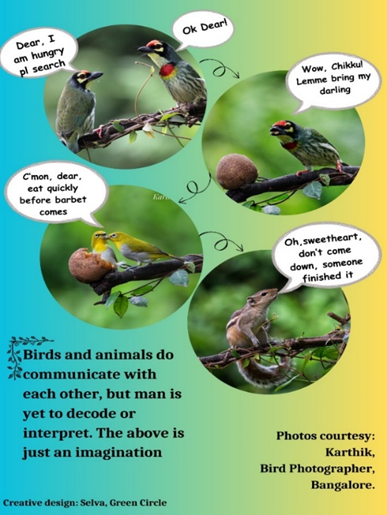
Similar thought haunted me, when the nature photographer Karthik shared with me his latest photos. On looking at a few Photos clicked by him in the same branch of a tree, in just an hour, a story emerged in my mind. Perhaps, it is only imagination, but there was some truth in it. First a Coppersmith barbet finds a Chikku and comes with its pair. They eat half of the fruit and leave. An Indian White Eye takes the leftover. Now the fruit is not there when a squirrel reaches the branch, and therefore it makes a sound. It appeared as if the squirrel requests its mate sitting in other branch not to come to avoid disappointment. (See picture). There is perhaps some kind of communication between animals, but we still can only imagine or interpret in our own way
Naturalists always try to decode the animal behaviour. But science is still evolving and there are many grey areas which is beyond man’s comprehension. The trumpeting of an elephant, the chirping of a bird, the roaring of a lion or barking of a dog tend to communicate something or other. Over a period of time, man mastered the art of communication between animals to a certain extent. The communication through sound, visual display, touch and chemical secretion are a few known ways the animals communicate. Right from hunger or happiness to love and sex, animals do express themselves from time to time. The courtship of birds is interesting and visible in fact.
But some of their communications are yet to be decoded. A new born baby cries when it feels hungry or when there is an insect bite or simply when she feels any discomfort. A mother by her experience and keen observation understands the child’s needs and comforts her. But many invisible emotions or discomforts often need medical intervention. Even a child specialist is not able to dragonize the behaviour often. As for as animals and birds are concerned, such behavioural interpretations may help conserving the species. Especially if the children are taught the behaviour in a lighter way with creativity and imagination in place, the desire for conserving them will be inculcated. Developing this interest in conservation is a science as well as an art. The educationalists should explore ways in lines of Walt Disney to create interest in animals.





 Dr V Selvarajan