Green fuel! Green crackers! Names are just greenwashing!

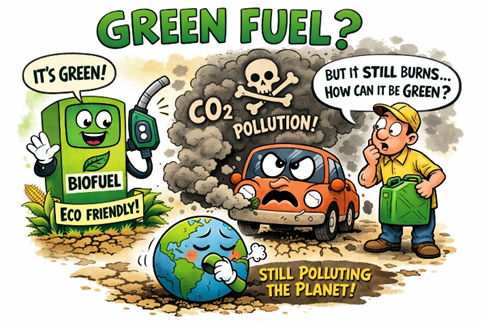
In today’s world, the terminology surrounding eco-friendly living is often both confusing and misleading, undermining the true essence of environmental responsibility. Could burning fuel be green? Could we burst crackers and call them green? Or do we really use biodegradable plastic? Green fuel refers to fuels that are considered eco-friendly because they emit lower greenhouse gas emissions and less pollution compared to conventional fossil fuels, namely coal, petrol, or diesel. However, the term is often used loosely, and sometimes misleadingly, in the public domain. CNG was considered an early green fuel. Non-conventional energy forms such as solar, wind, tidal energies are also considered eco-friendly and therefore ‘green’. And some advocate biofuel.When a fuel burns and emits carbon, how can it be green? Similarly, green crackers are just an ‘accommodating invention’ to appease the dogmatic beliefs. Green crackers are a category of firecrackers developed in India (mainly by CSIR-NEERI) to reduce air and noise pollution compared to conventional crackers. They were promoted especially after the Supreme Court restrictions on firecrackers. They are not ‘zero-pollution’ crackers but less polluting. The bitter truth is that the green crackers still emit particulate matter, sulphur compounds, nitrogen oxides, and CO₂. We can use the degrees of comparison for the ‘greenness’ of anything – green, greener and greenest. For instance, green crackers are greener than conventional crackers, but they are not the greenest. In that way, we can conclude that there is no greenest cracker. PM 2.5 peaks out during festivals, especially Diwali. We have reduced the bursting time to 2 hours, but not the volume of bursting.

Biodegradable plastic is not a solution to plastic pollution. Many products labelled as “biodegradable” do not actually break down in natural environments. For instance, Oxo-degradable plastics are not biodegradable but conventional plastics with metal salt additives. Microbes do not eat them, but they actually break down into smaller microplastics and nanoplastics. Plastics made from organic matter may degrade under industrial composting. Some plastics biodegrade but are costly. Some are partially biodegradable, as the plastic part remains as microplastics. One thing is clear, the world is yet to eliminate PLASTICS but tries to patch up, using biodegradability to its advantage.

In any case, GREENWASHING continues for sure!
Don’t use WhatsApp/Instagram frequently!

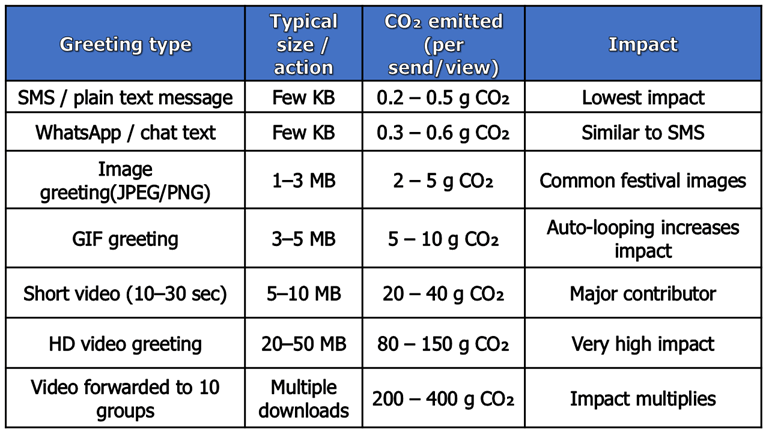
‘Your e-papers rely on circulation through social media. So, why are you stopping others from sharing these important messages?’ I can hear the whispers! That’s why I have cautiously used the word ‘frequently’ in the title. When we wanted to reduce paper usage, environmentally conscious persons started advocating the use of emails. Now it is time to caution against social media posts, or at least greetings. Digital greetings save trees and transport emissions, but excessive images, videos, and mass forwards quietly increase carbon footprints through energy-hungry data systems.  But the carbon footprint for online texting is better. We do not dispute it. The concern is about the huge volume of online messages. Data centres consume electricity as they process and store data at data centres, that run 24×7. They require electricity for servers and cooling devices, which is partly generated from coal or gas power. Every time we send a WhatsApp message, it travels through multiple servers. A Text message may consume very low energy, while a photo requires 10 times more data. Obviously, a video greeting requires hundreds of times more data. Sending the same video to many groups causes repeated downloads, multiplying energy use. Each greeting causes Screen lighting, CPU processing and Battery charging (indirect power use). So we can say that one message is tiny, but if it circulates a billion times, it matters together. Online greetings are still far greener than physical alternatives, but not zero-carbon. Cards with simple text or low-size images may be termed low-carbon cards. It is advisable to prefer them over repeated videos and autoplay videos. Deleting messages frequently is always good. We have given in the box the carbon emissions of online greetings, but they are only estimates, not precise. Understanding the impact helps. Instead of ignoring this topic, let us try to minimise usage to reduce harm to environment. Environmental challenges are subtle. It isn’t easy to decide what to give up and what not. Someone whispered to me that even our breathing releases CO2. That does not mean that we should stop breathing. When there is a significant impact on environment, it requires review.

“Digital greetings are greener than paper, but excessive images and videos quietly burn energy in remote data centres. Let us think globally and act locally”

Definition of mountains changing?

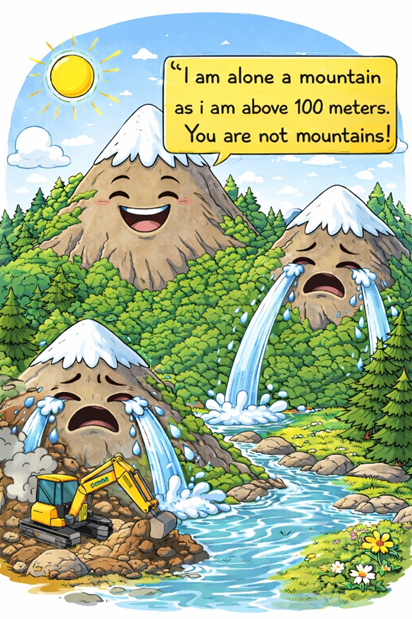
‘What is a mountain?’ If a teacher asks a primary class student, the future students may reply, ‘Any big rocky structure above 100 meters is a mountain’

Mountains that are less than 100 meters in height may not be classified as mountains. This observation is from the Supreme Court’s judgment in the Aravalli case on 20-11-2025, not my own definition. The Aravalli range has largely vanished, leading to protests in North India, particularly in Rajasthan, Haryana, and Delhi. I have nothing new to say, as the subject has already been extensively presented by the media and on social media. My only question is how this 100-meter benchmark has been finalised. Why 100 meters, why not 50 or 25 meters? I do not find any logic or rhyme in such a decision. The decision is arbitrary and challengeable. However, the decision is currently on hold. We need to wait for the Supreme Court to review its decision and possibly consider new definitions in January 2026.

The Aravalli Range is one of the oldest mountain systems in the world, and it faces multiple serious environmental and governance issues, especially across Rajasthan, Haryana, and the Delhi NCR. The core issue is illegal Mining. Extensive mining of stone, marble, and quartz has been occurring. Environmentalists argue that the mining leads to hill flattening, loss of vegetation, groundwater depletion, and dust pollution. The mining mafia is not ready to yield. The second important issue is the clearing of forests for real estate, roads, resorts, and agriculture, which leads to soil erosion and loss of native species. The Wildlife corridors are slowly destroyed due to rampant urbanisation & Real Estate activities. Forest land reclassified as “non-forest” or “revenue land” to permit construction, especially in Gurugram, Faridabad, Alwar, and Delhi NCR areas. The Aravalli range serves as a natural groundwater recharge system, but its destruction has exacerbated the water crisis in Rajasthan, Haryana, and Delhi. The loss of the Aravallis removes a natural barrier against desert dust from the Thar and contributes to severe air pollution in Delhi–NCR. The reduced carbon sequestration has already started creating havoc. There is a threat to biodiversity, and invasive species are seen replacing the natural flora. When the court takes up the case again in January 2026, we hope that some goodwill will prevail and the Earth’s oldest mountain will be saved from destruction. In the name of development, let us not dilute definitions just to accommodate vested interests and then do the mutual mudslinging at the cost of sustainable development