
“Cracker-free Diwali is just an annual slogan! No one cares!”. While this is the quick response from some frustrated environmental activists, there is a diagonally opposite descent note from protagonists of Dogmatic beliefs. For them, bursting crackers is not a big deal and will not do more harm to the environment than other pollutants. During Ram’s return to Ayodya, no crackers were burst. All lighted Diya to show their happiness. In those days Diwali signified the bringing of light and happiness around. Fireworks and the related chemicals were discovered much later during the last few centuries. Presently, the burning of firecrackers is the highlight of Diwali and for most people, Diwali is just a synonym for a night full of crackers, noise, and smoke. For some, firecrackers are burst because it is believed that they drive away evil spirits.
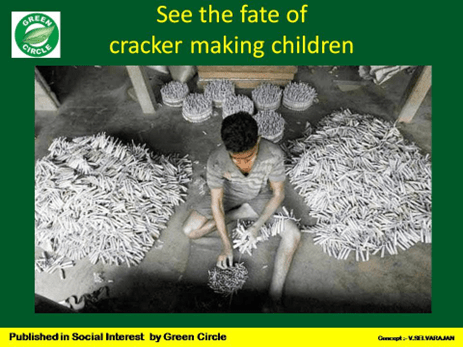
Today Diwali is nothing but a combination of health problems, and environmental degradation created due to air and noise pollution. Some even plead for the welfare of workers of the cracker factory, shutting their eyes to the fate of child labourers. (see picture). Despite objections from religious circles, the Government and Supreme Court together came heavily against bursting crackers, keeping in mind the primary concern of the health of senior citizens, children, and pregnant women. The Supreme Court has expressed concern over growing air pollution and the dire need to mitigate it. The cracker sound has undoubtedly become feeble, thanks to the CPCB guidelines on green crackers and bursting times. With the skyrocketing prices on the one hand and growing awareness on the other, Diwali by and large has been silent. According to the Supreme Court order, only green crackers made from eco-friendly chemicals were sold and burst. The timing for bursting crackers was restricted to 2 hours. Manufacturing firecrackers that emit more than 125 decibels were banned. The Chinese-made explosives were also banned. According to the CPCB standards, an AQI between zero and 50 is considered good, 51 and 100 satisfactory, 101 and 200 moderate, 201 and 300 poor, 301 and 400 very poor, and 401 and 500 severe. However, as expected, the AQI of Delhi has defied the firecracker ban during Diwali. On Friday, (1st Nov 2024) the city recorded the worst air quality with an AQI of 400 and above, according to the Central Pollution Control Board. By the time this paper goes to print, the Air quality will have increased beyond the permissible limit. As usual, many have deviated from the laid-down norms and burst crackers beyond the permitted timings. Green Crackers might not be the only crackers that had been burst. This is exactly what we have been experiencing year after year. Delhi is already reeling under pollution pressures as the stubble-burning season has begun. While the AQI in Delhi is hovering around 400 +, Bangalore is somewhere around 200 as of 1st Nov 2024. Precisely, all over India, the air quality has deteriorated to double its usual levels. We wonder whether the directives for cracker bursting are just a formality. There is no point in boasting that India has taken effective steps to check climate change unless we religiously follow the norms. Everyone must rise to the occasion to ensure clean air and silent celebration in the national interest.
 Dr V Selvarajan