
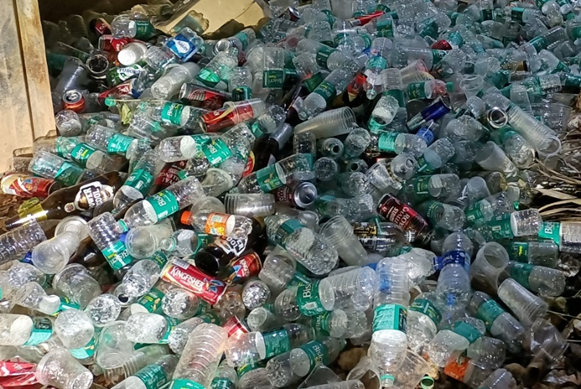
“Do not keep PET bottles on the stage during the event,” instructed an event manager at a national conference on climate change. He was extra cautious and wanted to protect himself from sharp remarks. Whenever an environmental event is planned, the organizers often meet and discuss how to make it eco-friendly. One school chief said that they do not accept anything that is not eco-friendly and even she refused to accept a cup won by students representing some inter-school nature contest. When we pointed out how her school had plastic chairs and tables, she had enough excuses like the plastic tables are used for a long time. Plastic manufacturers and consumers have ready-made excuses. It is indeed hard to completely avoid plastic as of now. Interestingly, though the PET bottles are of single-use, our question is why the Indian Government had not included them under the 21 SUP items that were banned on July 1st, 2022. Is there scope for managing these single-use plastic (SUP) bottles? The abbreviation PET is derived from the chemical name Polyethylene Terephthalate. The bottles made from PET are meant for single use. The manufacturers also claim that the PET bottles are recyclable and assert that 80% of used PET bottles are recycled. After accounting losses during sorting and processing, it is understood that 64% are effectively recycled into usable materials, especially in the textile industry. It is further learnt that 75% of such recycled PET (rPET) account for polyester fibres. If such a wonderful recycling opportunity is there, why are our water bodies, forests, green belts, and garbage dumps often seen cluttered with PET bottles? Prompt comes the reply. They are not PET bottles. They are thinner than PET material. Most of the PET water bottles are indeed made of thinner materials such as polyethylene (PE), polypropylene (PP), and polystyrene (PS). These plastics are often not recyclable or are difficult to recycle, leading to a significant amount of plastic waste ending up in landfills or polluting our oceans and natural habitats. So, it may be concluded that more studies must be made to explore whether all SUP bottles are recyclable. The urgent need is to identify non-recyclable plastic materials and include them under the SUP-banned items list. If no timely action is taken, the very purpose of the SUP ban will be meaningless
 Dr V Selvarajan