Trump changes the climate in the US!

It is all in the expected lines! US opts out of climate accord. The maxim ‘think globally and act locally’ is perhaps misinterpreted by Trump. He may be proud to be a ‘global’ leader, but, for climate purposes, he prefers to be ‘local’. For him, it appears that the sustainability of the planet Earth is immaterial. The US is a culprit in two ways. For one, they are the second largest fossil fuel producer and emitter. On the other, despite being an affluent nation, they are depriving their financial support to underdeveloped countries by stepping out of the Paris Accord. The accord works on the polluter-pay principle, but the US won’t pay henceforth. Another unfortunate Trump decision is to exit WHO.  Understandably, Trump is under compulsion to build America. His poll promise of nation-building seems to be Trump’s focus, and one has to appreciate his patriotic spirit. Nevertheless, Trump should not forget his responsibility as a world leader but has to balance between nation and world. We do not understand how a nation like the USA could afford to think environment to have jurisdiction. The pollutants emitted in America do not have a territory and will never stop within the four walls. Air is common to mankind, and the emission will travel beyond the boundaries. How could America forget COVID-19, which originated in China and traveled the entire globe? How can he imagine America being a ‘stand-alone island’ that could survive without mobilizing resources from other countries? In essence, global nations are interdependent in sharing natural resources. When the entire world realized this interdependency and started thinking from a broad perspective, it was a retrograde step to pull out of the Paris Accord. Climate change has already taken its toll throughout the world. Even the US has been affected recently due to the massive Los Angeles fire. El Nino effect is experienced everywhere. When the climate emergency has already set in, it cannot spare America just because it does not participate in global climate action. On the one hand, other signatories to the Paris Accord may follow suit and developed countries may pull out their commitment. On the other hand, the UN may experience a funding crisis in supporting third-world countries.

Perhaps the financial goals planned when the US was a partner to the accord need to be revisited. The need of the hour is for the member nations to come together and reset the climate mitigation goals. The member nations need to ignore the US while planning the future course of action as if the US is not in existence. Being the major contributor to emissions, the quantum of emission load from the US cannot be ignored. However, the revised climate goals must envisage a feasible and achievable target, sans America, at least for the next four years. Simultaneously, efforts must be on to convince the Trump administration to come into the ambit of the climate accord.  To sum up, climate change cannot wait for Trump and the ball must be set rolling. This is a ticklish issue but has to be tackled judiciously by other world leaders.

Early birds are late this season!

Bird lovers are highly disappointed!

Fewer migratory birds are spotted in Bangalore and other parts of the state. Climate change and global warming are cited as reasons for the drop in bird count. Most of the water bodies that house resident birds are seeing a decline in migratory birds. In Bangalore, winter months like November and December experienced a slight drop in temperature and January is expected to have a significant dip in temperature. In the first week of January, the forecast was that the minimum temperature may hover around 10°C during the next 10 days. Bird enthusiasts feel that Bangalore is slowly losing its bird population.

Migratory birds like Northern Shovellers, Northern Pintails, Common Pochards, Rosy starlings, and warblers were not spotted like in previous years. Migratory ducks like Garganey and sandpipers are recorded in fewer numbers. Someone had spotted the migratory Bar-headed geese near Mysore. Birders were anxiously searching for such migratory birds but to no avail. A decade ago, the migratory birds used to land in Bangalore says some avid birders. El Nino effect has undoubtedly cooled down the weather which should be suitable for birds to land here. Due to reasonably good rains, sufficient water is seen in lakes and waterbodies. Despite that, why birds have not landed here is a research topic. Incidentally, certain points need to be given attention. The garden city seems to be slowly giving up its green cover on the one hand due to rapid urbanization. This has led to massive encroachment of the buffer zones of the waterbodies. On the other, untreated sewage water enters the lakes in many cases. The water quality in these rain-fed lakes has deteriorated with no potential for aquatic life. This may be one of the reasons for birds to avoid the city’s lakes. Most lakes are under BBMP’s jurisdiction, so violations like letting sewage water in or encroachment in buffer zones are seen as a blatant misuse of power. Birds like painted storks prefer shallow water, while some migratory ducks are comfortable with more water. Researchers feel that deteriorating water quality is the major reason for the decline in bird populations. Populistic cosmetic changes like tiling the lake walking track, lighting the bunds, and providing park benches, or open gyms cannot revive the lakes. Unscientific de-weeding and desilting will end in biodiversity loss in lake ecosystems. Indeed, the authorities are also taking certain initiatives like Kere Mitra and online grievance redressal portals such as Janaspandana app and Sahaya app for quick solutions. However, most officials either remain insensitive or lack knowledge about ecosystem preservation and the importance of birds in the food chain. Against this backdrop, the naturalists and birders still hope that some migratory birds may land in the next few days. Global warming and climate change are attributed as reasons for the fast decline in birds, but the reality is that most changes are man-made (Rosy starling in the picture)

The ‘take, make, & dispose’ model must go!

‘Why this newspaper heap is lying here? ‘, an annoyed homemaker calls the kabaadiwalah (rag picker) to dispose of the same. The kabaadiwalah comes, weighs, and also pays a paltry sum. Of course, the homemaker, enriched by a few bucks for the old newspaper is doubly happy as the trash is cleared on one side and fetches some monetary gains too. The homemaker is not interested in what happens to the old newspapers after disposal.

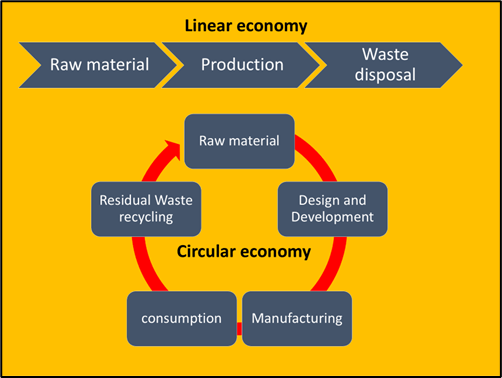
This is exactly the mindset of a producer or manufacturer on a larger scale. ‘We sell the scrap for a throwaway price and there are many takers’, said a manufacturer as if his production cycle is over as soon as he disposes of the waste, generated during production. He is clueless about what happens to the waste disposed of. ‘Take, make and dispose’ is the popular model of production in India which has done more harm than good. Such a model is popularly known as a linear economy which has been in practice ever since mechanization started in our country. Of course, the same conventional model is practiced in many countries. This is not only a concern in the manufacturing industry. It applies to all production activities. For example, consider what the farmers do in Punjab after harvest. They burn the stubble to clear the trash and prepare for their next season. Most of them know that stubble burning would lead to air pollution, but find it difficult to change the pattern that is being practiced till now, due to various reasons. The famous saying that ‘old is gold’ should not be forgotten. Not only this, the cycle of production will end only if the residue or waste is put to better use. Waste for one person will be a wealth for another. The linear economy believes that the production is complete once, the producer disposes of the waste. The Circular economy is more scientific and envisages full utilization of the wasted wealth in a productive manner. The producer becomes responsible for the waste generated. He has to ensure that the waste will be recycled and put to productive use. In Western countries waste picking, repairing, and recycling provides significant job opportunities. Therefore, the circular economy must replace the existing linear economy, which promotes better resource utilization, waste reduction, and recycling.  The circular economy takes care of the environment and saves nations from climate emergency. It should not be forgotten that millions of people die due to poor handling of waste and pollutants. Scrapped iron and steel, automobile junk, electronic waste, and rusted engineering goods have been piled up over the years. If we take stock of the waste being dumped in India, we will realize abundant potential within the country is available for better resource utilization. In India, the necessary shift to the circular economy is in the rudimentary stage as we do not have the required R&D allocations for this purpose. Policymakers are yet to realize the vast potential of optimal resource utilization. Continuous experiments on how resources can be better utilized should be the new paradigm shift in the research objectives of the scientific fraternity.