‘Why this newspaper heap is lying here? ‘, an annoyed homemaker calls the kabaadiwalah (rag picker) to dispose of the same. The kabaadiwalah comes, weighs, and also pays a paltry sum. Of course, the homemaker, enriched by a few bucks for the old newspaper is doubly happy as the trash is cleared on one side and fetches some monetary gains too. The homemaker is not interested in what happens to the old newspapers after disposal.
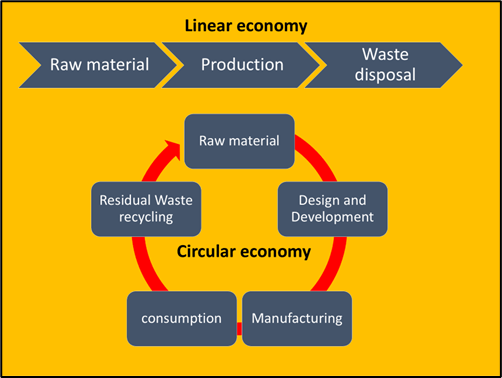
This is exactly the mindset of a producer or manufacturer on a larger scale. ‘We sell the scrap for a throwaway price and there are many takers’, said a manufacturer as if his production cycle is over as soon as he disposes of the waste, generated during production. He is clueless about what happens to the waste disposed of. ‘Take, make and dispose’ is the popular model of production in India which has done more harm than good. Such a model is popularly known as a linear economy which has been in practice ever since mechanization started in our country. Of course, the same conventional model is practiced in many countries. This is not only a concern in the manufacturing industry. It applies to all production activities. For example, consider what the farmers do in Punjab after harvest. They burn the stubble to clear the trash and prepare for their next season. Most of them know that stubble burning would lead to air pollution, but find it difficult to change the pattern that is being practiced till now, due to various reasons. The famous saying that ‘old is gold’ should not be forgotten. Not only this, the cycle of production will end only if the residue or waste is put to better use. Waste for one person will be a wealth for another. The linear economy believes that the production is complete once, the producer disposes of the waste. The Circular economy is more scientific and envisages full utilization of the wasted wealth in a productive manner. The producer becomes responsible for the waste generated. He has to ensure that the waste will be recycled and put to productive use. In Western countries waste picking, repairing, and recycling provides significant job opportunities. Therefore, the circular economy must replace the existing linear economy, which promotes better resource utilization, waste reduction, and recycling. The circular economy takes care of the environment and saves nations from climate emergency. It should not be forgotten that millions of people die due to poor handling of waste and pollutants. Scrapped iron and steel, automobile junk, electronic waste, and rusted engineering goods have been piled up over the years. If we take stock of the waste being dumped in India, we will realize abundant potential within the country is available for better resource utilization. In India, the necessary shift to the circular economy is in the rudimentary stage as we do not have the required R&D allocations for this purpose. Policymakers are yet to realize the vast potential of optimal resource utilization. Continuous experiments on how resources can be better utilized should be the new paradigm shift in the research objectives of the scientific fraternity.
 Dr V Selvarajan