
Is noise disturbing?

“Reckless people, they play music at loud noise!” a WhatsApp message jolted many!

We learned that the visibly fuming man was seen shouting at the top of his voice (is he not creating noise pollution?). The cause for his concern was a loudspeaker noise from a nearby venue. Most environment-conscious persons tend to overreact to the happenings around them. It was true that the organizers of a religious event kept the maximum volume to attract more crowds to their program. However, the organizers of the event were defensive. They claimed that the noise level was within permissible levels.

But the man was not convinced. He angrily left the place with his dog to let it open for pooping in public areas. In residential areas, the permitted decibels during the day must not exceed 55 dB but in commercial areas, the limit is 65 dB.  India would have been a silent country if we followed these benchmarks. But in reality, we hear noise everywhere. In foreign countries, drivers seldom blow their horns. But in our country, it is not uncommon to see the four-wheelers honking their horns, without reason. There are many spots where honking is prohibited. Seldom do we follow the rules. Humans can hear decibel levels starting from 0 dB and 120-140 dB, beyond which sound is a pain. 70 dB is equivalent to the sound level of a regular washing machine. It is also similar to the noise level in an office environment or inside a car driving at 60 mph. The. service providers of sound systems in functions know the permitted legal limits. There are devices to measure the magnitude of sound at a nominal cost of Rs 5000~10000. If anyone feels that the magnitude of sound exceeds permitted limits, one way is to approach the organizer of the events and advise them to keep within the limits. But in many cases, the advice falls on deaf ears as they are accustomed to noise and criticism. In such cases, the aggrieved person may file a complaint to the Police or the Pollution control board. In today’s lifestyle, everything crosses the limit. Noise is not an exemption.  We have seen that Delhi has turned into a gas chamber with no accountability for polluters. Encroachments are on the increase. Natural resources are depleted right in front of our eyes.  Fighting everything is disastrous. In Bangalore, we had an awesome airshow. The roaring 5th generation fighter planes like F16 and F35 spilled a huge level of smoke while creating immense noise. However, we enjoyed them because they are India’s pride. The protest of environmentally conscious citizens must be logical to the extent that all acts of civil society should lead to a prosperous life and ensure minimum damage to peaceful living. The fight with an ulterior motive of seeking attention is futile and will end in vain. Precisely, environmentalists must work on sustainable development and should not make a hue and cry for nothing.
Lake is not an amusement park!

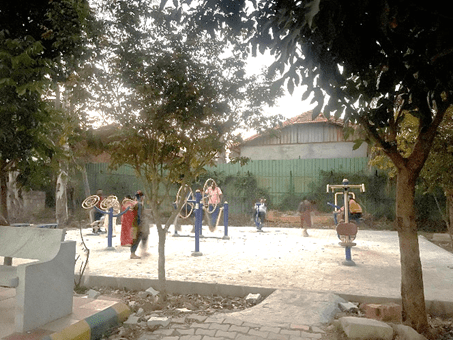
“Let’s go boating… let us have a food court… Let us have an open gym!”

There is no dearth of ideas! The general perception of a layman or user is that the urban water body is an entertainment center. For the local politician, the common man’s demand is the Magna Carta, as he perceives the public as his vote bank. For him, visibility is more important. According to him, all those visible cosmetic creations get converted into votes. In Bangalore, visionaries like Kempe Gowda, while building the city five centuries ago, were very particular about digging tanks and storing water for dry seasons. It is because of their far-sightedness that the city came into existence. The Mysore kings, including Krishnaraja Wodeyar and Tipu Sultan, and German botanist Gustav Hermann Krumbiegel, are responsible for making Bengaluru the “Garden City of India.”  Bangalore is also known as lake city. Once more than 1000 lakes were in Bangalore. Now, the number of lakes has shrunk to less than 200.  Majestic bus stand, hockey, and football stadia were once scenic lakes. If the situation continues, Bangalore will have only a few lakes, left out. However, the common man is interested in providing a walking track, Gym, and children’s play areas in the left-out lakes. Some demand a gym, some insist on street lights, and thus facilities and conveniences are added to entertain users. Some lakes provide boating facilities. In some lakes, there comes a musical fountain and a toy train. Thus, the lakes turn into an entertainment hub. In a nutshell, such activities are cosmetic and are made to satisfy the vote bank of the politicians. Most of the lakes are encircled by walking tracks. Though tiling or cementing of the walking tracks may help walkers to make a smooth walk, the cementing prevents water percolation and destroys the natural bunding that existed for centuries. Instead of encouraging native trees, exotic trees are planted in the bunds. Artificial sheds and shades are constructed on the bunds in some lakes. But this main focus of the lakes has taken a backseat. The water quality and biodiversity of a lake define its health. These two are indeed interdependent. Parameters like pH, Dissolved oxygen, and turbidity determine the aquatic flora and fauna.  The lake ecosystem ensures support for hundreds of microorganisms and aquatic life. Unfortunately, biodiversity conservation is not at all a priority for authorities. Even if some attention is given, it is done just for the namesake.  The important function of the lakes is water storage apart from groundwater recharge. Water quality is the first and foremost concern. However untreated sewage is being let into the lakes in many places. De-weeding is not conducted scientifically, which weeds away the valuable water plants and grasslands. Desilting and dredging are not periodically undertaken to clean up sedimentation. If we want to save the existing lakes, awareness must increase among the people, politicians, and bureaucrats about the importance of lake ecosystem conservation.

The lacklustre attitude to lakes will wipe out groundwater and natural rainwater storage in cities.

Deepfake AI birds mimic natural birds!

‘Such a beautiful bird I have never seen!’

With this exclamatory mark over his head, one WhatsApp warrior forwarded a clip of a few most colourful birds with beads of pearls, impressive eyes, and gorgeous feathers. The interesting part was when he asked me to identify the same. When I received a similar clip for the first time, I was curious to find out where exactly this bird lived. I even cursed myself for not coming across such unique birds, though I have been birding for over 4 decades. In real life, I always lament over my inability to spot the Himalayan Monal. Even the most shining and colourful Monal cannot beat these birds. Slowly, I started realizing that these are AI-generated images. Of late, the moment I received a video from a friend of mine asking for bird identification, I learned how to differentiate and promptly text the sender, it is an AI-generated image. In the last two decades, moviemakers have used AI techniques to create mind-boggling films. The turn of the 21st century has opened up the potential of electronics and opened Pandora’s box of opportunities in the IT industry. In that sense, it is not out of place to mention that those born between the 1950s and 1980s were the luckiest people to have the last chance to glimpse a world full of natural abundance. The turn of the present century witnessed natural disasters, man-made destructions, and unimaginable industrial developments. Nature is being molested and natural resources are vanishing. The day is not far off for fixing the last nail in the coffin of fossil fuel. On one side, this is happening, while on the other hand, we are inching towards an artificial lifestyle. AI appears to be destructive rather than constructive.  One of the identified AI images is physical malformation. For instance, if a snake is depicted with an unproportionate head or a horn in the head, one can easily distinguish between a natural and an artificial one. A logical understanding may help differentiate between an AI image and a natural one.  Recently, a video clip with a buffalo was shown to house a bird nest between its two horns with a juvenile living inside. Is it possible? Won’t the animal lie down, move its head, dash against another animal, or sleep? Nesting is an avian instinct to safeguard juveniles. So, this is a clear case of logical inconsistency. Sometimes, AI algorithms meticulously work frame by frame, to make the clips appear genuine. There is one dangerous development, known as Deepfakes. Such AI clips may become the most harmful tools for concocting stories that will appear original and real. One day, a Prime Minister may appear on the TV screen and say that an emergency has been clamped. Or a tiger may enter your residential area and might even kill a child. Or there may be a devastating fire in the school where your child is studying. Or a tsunami has set in the Bay of Bengal and would engulf Bangalore in another 3 hours, creating panic. Sad indeed! AI tools may be used to predict rains, track unknown species, or a potential forest fire, but not to flood social media with absurd images just to gain viewership.  Necessary legal validation protocols must be in place to prevent the onslaught of AI in social media.