
Fallen dry leaves – menace or manure?

Dry leaves are a menace! We are fed up with them when the trees shed their leaves during dry periods!

It is quite strange to see many getting disturbed about the dry leaves. More often, we find people burning the fallen leaves because they do not know what to do with them.  Of course, the ‘easiest’ way to dispose of waste, garbage, and plastic items seems to be burning. Burning releases the carbon trapped in dry leaves, emitting harmful gases and even worse particulate matter.  In India, there are generally two dry seasons during which leaves are shed, namely, just before the monsoon and summer. The most common of these are Neem, Populus, Maple tree, and Peach. Leaves reappear with the arrival of the spring season. This process of shedding leaves is called as abscission or leaf fall.

The trees that shed leaves are called deciduous trees. Before shedding, leaves change colour from green to yellow or red/brown and finally fall. Such fallen leaves are a valuable resource for gardening and landscaping. Dry leaves are a type of organic matter that is high in carbon and low in nitrogen. They are often dry, brittle, and may retain their original structure. Used as mulch, they can retain soil moisture, insulate plants from cold, and suppress weeds.  Dry leaves may become compost and contribute to soil health by providing a natural fertilizer. Additionally, they can be used in craft projects and even as insulation for garden sheds. A healthy soil consists of humus, the organic component of soil, primarily composed of decayed plant and animal matter. It includes carbon, nitrogen, and other elements like phosphorus and sulfur. 

The best way of managing dry leaves is to leave them where they fell. Perhaps some may be skeptical when I say this. But consider this. There are vast areas of forests where, every season, trees shed leaves, but no one is concerned about that. What happens to these leaves? They decay, decompose, and become the organic component of the soil, namely humus. This enables new trees to get manure from decomposed animal and plant matter. Soil that consists of sand particles only has no nutritional value except that it holds the roots. It is the organic matter that further gets converted into nutrients, such as nitrogen (N), phosphorus (P), and potassium (K), as well as organic compounds and essential elements necessary for plant growth. If someone still wants to treat the dry leaves, they can try composting or using them as mulch. Composting helps improve soil, while mulching provides moisture retention and weed control. In the 90s, I used to trek into the dense evergreen forests (Sholas) of Kodaikanal, which are known for their spongy floor. The floor may hold fallen leaves that could be dated a few thousand years. The leaves mix with rainwater to serve as a blotting paper, giving a cushioning effect while walking. If one experiments digging to trace the rock bottom, it may be about one or two meters deep sometimes. These are all the sources of fertility of the soil. Dry leaves and dead animals are great contributors to soil fertility. They are not a menace. Nature has appointed them to do so. We should not create a barren land, but leave the dry leaves as such.

Environment, the biggest war victim!

Tit for tat, eye for eye… such emotional outbursts are quite common when it comes to war! The common man thinks the solution to all terrorist activities must be responded to on the same scale. Especially those who were affected by a bomb blast, a terror activity, or an unprovoked attack will feel so, and it is but natural. However, the cost of such attacks cannot be compensated by either money or revengeful retaliations. True that such heinous crimes will end in a large-scale disaster if not arrested in time. However, history has shown that the war is not a permanent solution. When the missiles and drones pitch fire on undisclosed targets, it is beyond doubt that there will be huge collateral damage besides the targeted spot. Tracing the flesh and blood of human bodies and animals amidst the rubble is pathetic. Leave alone the valuables that get destroyed in the attacks. We are daily hearing stories of one or other attack on the Gaza Strip or the Russo-Ukrainian War.

Thousands of multi-story buildings, passenger vehicles, and other properties are being reduced to rubble, rubbish, and ruins. Economic loss apart, we have witnessed the drastic destruction of the environment. War and armed conflict significantly degrade the environment through various means, including direct destruction of ecosystems, pollution from military activities, and the exploitation of natural resources. These impacts can lead to long-lasting consequences like food and water insecurity, biodiversity loss, and the displacement of populations. Construction of military bases may destroy forests, wetlands, and other natural habitats, leading to habitat loss and biodiversity decline. The chemical weapons may affect water sources, soils, and air with hazardous substances. Flora and fauna will be destroyed, leading to a loss of biodiversity. Innocent civilians may be displaced. The overuse of fossil fuels by military aircraft will emit greenhouse gases. The military attacks mostly target fuel tanks and stations, which speed up the shrinking of fossil fuel stocks. When emotions flare up, there will be an excitement in favour of war. Politicians take mileage out of such mass psychology. Graphics in news media channels showed jaguars, missiles, and drones flying crisscross the TV screen, giving a feel of seeing war pictures of a possible 3rd World War. Any such act might result in the escalation of the war situation and the ultimate decimation of the precious natural resources. Besides innocent lives, the ultimate victim would be the environment. We should not forget that a 3rd World War would make the planet Earth a barren land (Picture courtesy: a representative picture from the Internet)

Trees don’t come free!

Published on 10.5.25 in South Express

Why are trees always targeted? Are there no alternatives for trees? Can’t we produce more oxygen in the lab?

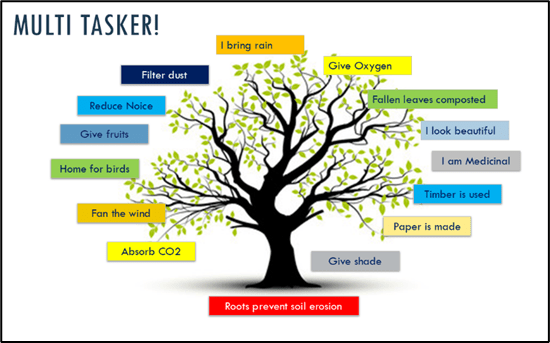
Such questions repeatedly surface among students. Why are trees treated as priceless? Is it true that we can’t estimate the worth of a tree? Long ago, a research study computed the value of a grown-up tree as Rs 1 Crore. In January 2020, then Chief Justice S.A. Bobde instructed a committee of experts to evaluate the loss of trees to the environment. The panel estimated the economic value of a tree as Rs 74500 multiplied by its age. In other words, a 100-year-old tree will be worth Rs 74,50000. Heritage trees with a lifespan of over 100 years could be valued at more than Rs 1 crore. By adding the costs of micronutrients and compost, living trees will more often than not outweigh the benefit of most of the projects they are felled for, as per the committee’s report. Unfortunately, when calculating the cost-benefit analysis of an infrastructure project, the authorities never speak about the environmental costs of felling trees for the project. Project reports make a passing remark, that’s all. Sometimes the reports suggest transplantation of well-grown trees, but do not discuss the feasibility of transplantation and maintenance. In Bangalore, the Metro rail construction had initiated compensatory plantation. But there is no provision for a reality check about the number of trees removed or the number of trees compensated. Even if ten saplings are planted for felling one tree, where is the real compensation for the environmental degradation meted out to the spot where the felled tree existed?   Moreover, ten new and young saplings cannot compensate the loss due to the felling of a 50-year-old tree in terms of the economic values as mentioned above.

While everyone knows the environmental value of a tree, it is painful to note that all over India, whether it is Hyderabad, Bangalore, Delhi, or Uttarakhand, massive tree felling has become the order of the day, in the name of a new infrastructure project. Nowadays, wherever new projects are proposed, the contractors erect huge compound walls that hide the happenings behind the walls. After erecting walls, whether tunneling, felling trees, or destroying a water body, becomes easier. Recently, a small forest stretch near Dwarka, adjacent to the International Airport, vanished overnight. Tree felling happens at midnight when the world sleeps, using chainsaws within a fraction of a minute. The old timers cannot forget the once beautiful PUSA road in West Delhi before the erection of metro pillars. Those born after 2000 may not even imagine that the road was once a boulevard. We do not preach against development, but the planners of development conveniently forget the economic value of trees and blame climate change when the weather is getting hotter. Bangalore, the once garden city is now a concrete jungle!

The tunnel that jerks our hearts!