
Published on 10.5.25 in South Express
Why are trees always targeted? Are there no alternatives for trees? Can’t we produce more oxygen in the lab?
Such questions repeatedly surface among students. Why are trees treated as priceless? Is it true that we can’t estimate the worth of a tree? Long ago, a research study computed the value of a grown-up tree as Rs 1 Crore. In January 2020, then Chief Justice S.A. Bobde instructed a committee of experts to evaluate the loss of trees to the environment. The panel estimated the economic value of a tree as Rs 74500 multiplied by its age. In other words, a 100-year-old tree will be worth Rs 74,50000. Heritage trees with a lifespan of over 100 years could be valued at more than Rs 1 crore. By adding the costs of micronutrients and compost, living trees will more often than not outweigh the benefit of most of the projects they are felled for, as per the committee’s report. Unfortunately, when calculating the cost-benefit analysis of an infrastructure project, the authorities never speak about the environmental costs of felling trees for the project. Project reports make a passing remark, that’s all. Sometimes the reports suggest transplantation of well-grown trees, but do not discuss the feasibility of transplantation and maintenance. In Bangalore, the Metro rail construction had initiated compensatory plantation. But there is no provision for a reality check about the number of trees removed or the number of trees compensated. Even if ten saplings are planted for felling one tree, where is the real compensation for the environmental degradation meted out to the spot where the felled tree existed? Moreover, ten new and young saplings cannot compensate the loss due to the felling of a 50-year-old tree in terms of the economic values as mentioned above.
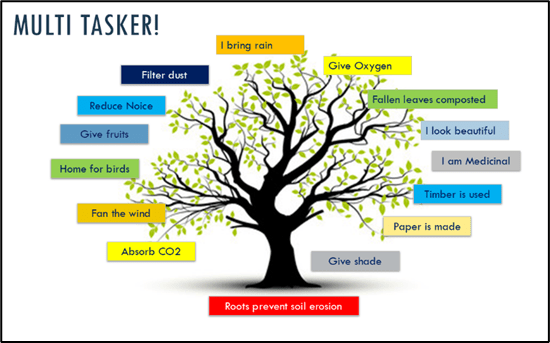
While everyone knows the environmental value of a tree, it is painful to note that all over India, whether it is Hyderabad, Bangalore, Delhi, or Uttarakhand, massive tree felling has become the order of the day, in the name of a new infrastructure project. Nowadays, wherever new projects are proposed, the contractors erect huge compound walls that hide the happenings behind the walls. After erecting walls, whether tunneling, felling trees, or destroying a water body, becomes easier. Recently, a small forest stretch near Dwarka, adjacent to the International Airport, vanished overnight. Tree felling happens at midnight when the world sleeps, using chainsaws within a fraction of a minute. The old timers cannot forget the once beautiful PUSA road in West Delhi before the erection of metro pillars. Those born after 2000 may not even imagine that the road was once a boulevard. We do not preach against development, but the planners of development conveniently forget the economic value of trees and blame climate change when the weather is getting hotter. Bangalore, the once garden city is now a concrete jungle!
 Dr V Selvarajan