Bike Taxis, E-Rickshaws: – eco-friendly & economical

Bike taxis of Bangalore are banned! E Rickshaws of Delhi are not regulated!

From June 16, 2025, there will be a ban on e-rickshaws. It is a court decision. under Section 93 of the Motor Vehicles Act and the Rules, bike taxi services cannot operate in Bangalore unless the state Government brings out a set of regulations. Aggregators claim that they are covered under the Karnataka On-Demand Transportation Technology Aggregators Rules, 2016. But the court has directed the State Government to frame a set of regulations for bike taxis. Young drivers who relied on this part-time job to meet their daily expenses are now at a loss. There are many reasons for this decision. One argument is that the safety of the passengers is at stake. There is a hue and cry about the behaviour of bike taxi drivers. Recently, a bike taxi driver slapped a lady customer, but we learned that the lady had slapped him first, because his driving was rash. Others say that this was nothing but yielding to the pressure from other transporters like taxis and auto rickshaws.

But we are looking at a different perspective. This bike rickshaw is eco-friendly because it carries one passenger, whereas cabs also transport one, not to full capacity. For one, it adds to carbon footprints due to the wasteful fuel consumption. Secondly, it adds to Bangalore’s traffic jams. It is neither eco-friendly nor economical. One advantage of bikes is that they provide last-mile connectivity. It is safer for riders, especially women, since they commute in open space. Similarly, e-rickshaws are battery-operated and considered eco-friendly. They are economic too. Transportation evolved from horses, camels & elephants, bullock carts, tongas, chariots, and even hand-pulled rickshaws followed by cycles and cycle rickshaws. Diesel engines replaced steam engines. Petrol, aero-fuel, and CNGs are evolved later. Now we are inching towards battery-run automobiles. Solar vehicles are also being tested. As and when technology evolves, the policy makers need to look at the sustainable alternatives. FASTER, CHEAPER and BETTER are the 3 important watchwords that need to be considered in choosing the acceptable mode of commuting. Especially as the cities are expanding dramatically, the word BETTER assumes importance. It means safety, feasibility, last mile connectivity and sustainability. Hope that Government considers all these aspects and put in place a regulated transport mechanism
Stampede massacres, footboard butcheries, road accidents

Are they all due to officials’ negligence, public callousness, political empathy, or a surge in population?

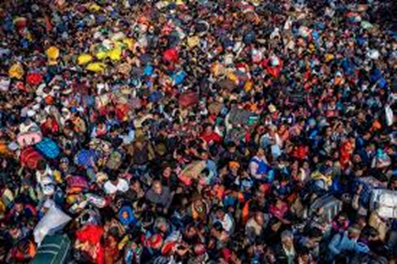
Why did the Bangalore RCB stampede in the Chinnaswamy stadium on June 5, 2025, result in at least 11 deaths and 33 injuries? A stampede at New Delhi Railway Station on the night of February 15, 2025, resulted in at least 18 fatalities and 15 injuries. 30 people died and 60 were injured in a stampede at the Maha Kumbh Mela in Prayagraj on January 29, 2025.  During the Pushpa 2, one woman died when she came to see Allu Arjun on December 4, 2024. The reason for the recent Mumbai train deaths is attributed to overcrowding, which made passengers clinging to the door fall onto the railway line and be run over by a train from the opposite direction. Why did the Kumbh Mela deaths happen?  At least 82 people were killed in four incidents of stampede at Maha Kumbh in Uttar Pradesh’s Prayagraj on January 29, against the State government’s official claim of 37 deaths, a report by BBC News Hindi claimed.

After any mishap, many doubts arise in our minds!  We need to apply our minds to understand and avert future occurrences of similar incidents.  We should develop a similarity to all these incidents. One common reason is the bungling, callousness, and lack of far-sightedness of the people at the helm of affairs. Crowd management is a tricky proposition. In a wedding ceremony, if 300 people are expected, but 1000 turn up, arranging food is a challenge. If we arrange food for 300 while only 100 turn up, it is food waste. It is a catch-22 situation. Overcrowding is not an isolated problem for any city. Such stampede incidents are increasing nowadays. Airports look crowded bus stations, and incidents of verbal fights between staff and passengers are reported. Airlines started advising passengers to report 4 hours in advance to avoid congestion. As the workload increases multifold, the administrative staff find it stressful to work. So, who is to blame, the Government, people, bureaucrats, workers, or infrastructure? This blame game will serve no purpose. India should plan a holistic approach to all crowd-related issues. We have seen two such occasions in general. Firstly, such unpredictable stampedes occur during religious or sports gatherings due to a sudden influx. The second one is routine and happens in bus stands and railway stations, where people violate the rules to reach their destination on time. While the permission in the first instance, which is unpredictable, should be on a selective basis, the second one must be managed professionally by deploying a better workforce and risk management tools, as it is somewhat predictable. The main reason behind the recent stampedes, due to overcrowding, is India’s unabated population growth. India’s major problem is our rapid population growth. We have surpassed China’s population figure. Our population is 143.81 crores (as of 2023). Now this must be still more. In the last century, we had fewer instances, while challenges are more prevalent at present. On July 11, every year, the whole world pledges to control population growth, but unfortunately, life goes on as usual. The ensuing period will be more challenging!

10000 strong human chain to arrest waste burning!

A human chain that vows to handcuff the proponents of a lethal biogas plant in the North Chennai residential area!

In the South Express issue of April 26, 2025, we reported the unhappiness of the residents against the Greater Chennai Corporation’s (GCC) waste-to-energy (WTE) project at Kodungaiyur in crowded North Chennai in our editorial. We also highlighted that the residents came together under the Federation of North Chennai Resident Welfare Associations on April 13, 2025, to protest against the GCC’s WTE component of the integrated waste management facility (IWMF), planned for Kodungaiyur in North Chennai, on a 75-acre Metro water land near the existing dump yard. The trigger for the people’s unrest was the recent signing of an agreement to burn 1400 tons of non-biodegradable waste generated in a day. The project involving Rs 1026 Cr was to be implemented in 25 years under a Public-Private partnership. The Federation passed a resolution to stage a massive human chain on 25th May, 2025. There was no positive response from the Corporation.

As planned, the 4 km long human chain started from Kodungaiyur and ended at Vyasarbadi Ambedkar College. One who knows the intricacies of event management for such non-political, non-governmental movements will agree that it is not an easy task to bring together 10,000 people in a single line to form a mammoth human chain. The fact that 10,000 gathered to form the chain speaks to people’s commitment to stopping the massive waste burning. People who joined the signature campaign and human chain demonstration are mostly from a marginalised community in the thickly populated North Chennai Corporation area, who always felt that they were the most neglected lot. Understandably, landfills and pollution had already taken a heavy toll on their health and lives in the last 3 decades. The proposed waste burning project will only add to the misery of their lives. The President of the Federation, T.K. Shanmugam, asserts in a press release that they do not advocate any alternative model for the incinerator but reject the very burning of waste. One can feel the pain in his voice, and it is not just his voice but that of millions of residents around. Why don’t they relocate the project near the Secretariat, if it is not going to be harmful, asks Shanmugam. Federation demands the scrapping of the project. They want the Government to expedite the retrieval of the 352 acres of landfill area by biomining and establish a mega library, an international auditorium, a medical college cum hospital, an indoor stadium and a biodiversity park. Demanding an exclusive environment policy for North Chennai, the Federation pins its hopes on a positive response from the Tamil Nadu State Government and North Chennai Corporation. Pure water and clean air are often a distant dream, especially for the marginalised community. Only time will tell whether their hopes will come true!

Nature’s journey from the Jurassic to the AI era

Which nature do you want to save, … the man-made one you see today, or the original one? ‘This question from the audience shattered me,’ said my friend Prof Rajesh Gopinath, an environmentalist who was part of a panel discussion. Getting back to normalcy, he replied, ‘Choice is yours, but Mother Nature will not wait for you to save her.’ ‘It was indeed a good reply.’ I told Rajesh, but in a way, he had provoked my thoughts. I asked Rajesh, ‘What is ‘man-made nature? What did that participant want to know?’ Because if man creates nature, it is unnatural and not natural. So, for me, it appears that man-made nature is one that evolved due to the exploitation of natural resources. It is the human-nature interface that has changed the very definition of what was once natural. What our forefathers saw on planet Earth is not what we are seeing today. On the one hand, it was due to natural evolution over millions of years, and on the other, the man-made destruction in the last few decades.

Could we recreate an environment where dinosaurs were freely moving on the planet? Science has relied on certain assumptions based on material evidence and theories constructed thereon. We can only simulate that Mother Nature was like this during the Jurassic era, or perhaps see the movie Jurassic Park again to relive the bygone era. Nature has undergone changes that are beyond human conception. Those who lived in the 20th century during their early years and are still living in the 21st century, like me, may perhaps speak and recollect the school days when, on holidays, we visited the nearby villages, spent time on farms, and enjoyed swimming in the small rivulets. Where are those rivulets now? Right under our noses, we miss the sparrows to a large extent. Many bird and animal species have become extinct. The smell of soil when it rains and the frequent rainbows, lightning, and thunder are now rarities.

Precisely, today’s nature is not what people like me experienced during their youth. Within 50 years, I can confidently tell that the present-day environment is not the same as the one that prevailed in the 1960s and 70s. Anthropological changes have impacted nature. The pre-industrialisation era was far better than what it is now. Rightly, the Paris Convention decided to reverse the damage that human beings had made to the environment, choosing the pre-industrialisation global mean temperature as a benchmark.  It is understandable because we cannot return to an endless past, and we need a zero point to go forward. Global warming and climate change are major concerns today. We continuously debate how to reduce carbon footprints. Sustainable Development Goals (SDGs) are now deadlines that institutions struggle to meet within the given time frame set by their duty-bound bosses, least realising that the environment can never be saved in air-conditioned halls. Only a few like Rajesh take it seriously and wish to contribute their part to nature. Let nature be natural, and humans, who live for a short while, must not tamper with it (Representative picture from the internet)