Lockdown lessons unlearned!

‘Bhool gaya sub kuch, yaad nahi ab kuch’

I am reminded of the above lines from a song in the popular old Hindi film Julie. Yes, we have forgotten everything we learnt. COVID-19 was a global crisis that demonstrated how nature would beh

ave if we do not take corrective steps. The lockdown call alerted every nation that immediate action was needed to avoid a point of no return. Nature also showed us how the world would appear if we were locked inside homes for a fortnight. The roads were empty, and the pollution index slipped to low levels at places like Delhi. People were inside their homes but breathed fresh air, as there was no human activity outside. The coronavirus was discovered in Wuhan, China, in November 2019, and was named COVID‐19. The disease is a class of epidemics with human‐to‐human transmission caused by severe acute respiratory syndrome coronavirus 2 (SARS‐CoV‐2). Later, the medical fraternity discovered several mutated variants. By 2022, the world reported 551 million cases in 194 countries, out of which about 6 million fatalities resulted.  While the exact animal source remains unconfirmed, evidence suggests bats as the natural reservoir and potentially an intermediary animal host, such as a pangolin, civet cat, or raccoon dog, as the direct source of transmission to humans. Primarily, the man-animal conflict is a major concern in conservation. When nature is disturbed, aberrations in the food habits of wildlife tend to happen. Coupled with this, habitat destruction also leads to changes in the animals’ behaviours. When it was discovered that the pangolins, bats, and Civet cats were the carriers of the COVID-19 virus, it was shocking because these wild animals have been in existence for millions of years in the evolutionary tree. Suddenly, how do these animals become the carriers?

One more interesting thing that happened during the lockdown period was that many wild animals, like leopards and tigers, roamed freely in towns. During COVID, many on social media expressed their concern for protecting wildlife and our forests. Simultaneously, people breathed clean air. Many wondered whether this lockdown period is a cautionary bell to human beings to mend their ways and lead an eco-friendly lifestyle. That’s all. It appears that we do not learn from mistakes.

“Learn, Unlearn, relearn” seems to be the maxim we follow, I guess.
India is at the top of the world population!

Not an achievement to celebrate!

UN observed World Population Day on 11th July as usual. Looking at the UN data, it appears that the population dynamics are changing. India has surpassed China in population. India’s population is estimated to be 146.39 crore (1.4639 billion) as of April 2025, according to a UN report. The report also notes that India’s total fertility rate has fallen below the replacement level, and the population is expected to reach 170 crores before starting to decline in about 40 years. It is good that the population growth rate will slow down in the next 40 years. It is very much needed. But what is the guarantee for the same? It took hundreds of thousands of years for the world population to grow to 1 billion, then in just another 200 years or so, it grew sevenfold. In 2011, the global population reached the 7 billion mark, it stands at almost 7.9 billion in 2021, and it’s expected to grow to around 8.5 billion in 2030, 9.7 billion in 2050, and 10.9 billion in 2100. This dramatic growth has been driven largely by increasing numbers of people surviving to reproductive age, and has been accompanied by major changes in fertility rates, increasing urbanization, and accelerating migration. These trends will have far-reaching implications for generations to come. Moreover, the resources needed to sustain the population growth are inadequate. A comparable nation, China, with 2.5 times the land mass, has been able to manage its population control. In India, we do not seem to have taken any adequate steps to control the growth rate. We find that every city is becoming congested, day by day. The supply of resources is not commensurate with the population. Our resources are depleting on one hand, and on the other hand, more consumption is taking place due to population growth. Apart from this, every city is overcrowded, leading to traffic congestion. Further, cheating and corruption are offshoots of such a demand and supply gap. We are also forced to take substandard quality materials, both in terms of food and consumer goods.  In my opinion, the spurt in population numbers has resulted in environmental degradation directly and indirectly. India’s population is a serious cause for concern. Small family norms must be publicized again, and sincere efforts to educate the people to adopt small family norms as were vigorously practiced in 70s and 80s.

Single-use plastics Ban completes 3 years

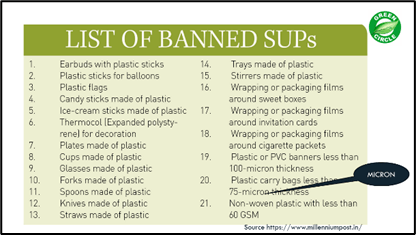
Is the SUP ban effective? On July 1, 2022, the Government of India proudly announced the ban on single-use plastic (SUP). 3 years have passed since then. Where are we now? Are we finding our water bodies free from SUPs? Do we see our households rejecting plastic bags? Have we reached at least half of what we contemplated when the ban was announced? The questions remain unanswered. Single-use plastics are still in use. The Central Pollution Control Board issued a list of 19 single-use plastic items that are banned. The ban on single-use plastic items includes straws, cutlery, earbuds, packaging films, plastic sticks for balloons, candies and ice creams, and cigarette packets, among other products. SUPs are just about 10% of the total plastics, according to some studies. However, single-use plastics are the real culprits in clogging our waterbodies. These items are thrown everywhere by consumers and remain as an eyesore for days since civic authorities never remove them immediately. Even if removed, they reach landfills and get stuck there forever. Besides, the micro and nano-particles of plastics from such SUPs are responsible for cancers and pollution related diseases

State Pollution Control Boards and Pollution Control Committees are expected to impose a fine on the defaulting producer of Single Use Plastic, and Local Bodies should impose a fine on Retailers, Sellers & Users of Single Use Plastic. However, it appears that these penalties do not work as deterrents. For one, the enforcement is not strict for reasons well known. According to some, the ban was not a complete one as long as PET bottles are included in the SUPs. PET (Polyethylene terephthalate) bottles are not classified as SUPs in India as they are excluded as per the Plastic Waste Management Rules, 2016 (as amended in 2021), as long as they are collected, recycled, and reused effectively. The argument in favour of PET bottles is that they have high recyclability and there is an established infrastructure for collecting and recycling. It is also felt that PET bottles are reusable.  The Indian government excluded PET bottles from the ban, subject to the producers’ compliance with Extended Producer Responsibility (EPR) norms under the Plastic Waste Management Rules. But misuse or poor waste management could still make them environmentally problematic. By the way, the SUP items like earbud sticks, straws, and stirrers, which were included in the Banned items, may not contribute significantly to environmental pollution. Under the circumstances, a review of the impact of the ban on SUPs is the need of the hour. On the one hand, the restrictions on the manufacture of SUPs must be strictly enforced, and many items must be added to the existing banned items.