

Is the SUP ban effective? On July 1, 2022, the Government of India proudly announced the ban on single-use plastic (SUP). 3 years have passed since then. Where are we now? Are we finding our water bodies free from SUPs? Do we see our households rejecting plastic bags? Have we reached at least half of what we contemplated when the ban was announced? The questions remain unanswered. Single-use plastics are still in use. The Central Pollution Control Board issued a list of 19 single-use plastic items that are banned. The ban on single-use plastic items includes straws, cutlery, earbuds, packaging films, plastic sticks for balloons, candies and ice creams, and cigarette packets, among other products. SUPs are just about 10% of the total plastics, according to some studies. However, single-use plastics are the real culprits in clogging our waterbodies. These items are thrown everywhere by consumers and remain as an eyesore for days since civic authorities never remove them immediately. Even if removed, they reach landfills and get stuck there forever. Besides, the micro and nano-particles of plastics from such SUPs are responsible for cancers and pollution related diseases
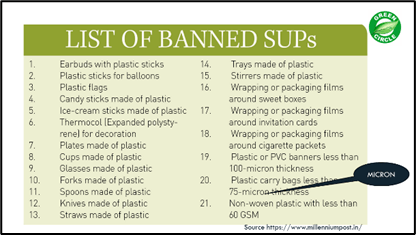
State Pollution Control Boards and Pollution Control Committees are expected to impose a fine on the defaulting producer of Single Use Plastic, and Local Bodies should impose a fine on Retailers, Sellers & Users of Single Use Plastic. However, it appears that these penalties do not work as deterrents. For one, the enforcement is not strict for reasons well known. According to some, the ban was not a complete one as long as PET bottles are included in the SUPs. PET (Polyethylene terephthalate) bottles are not classified as SUPs in India as they are excluded as per the Plastic Waste Management Rules, 2016 (as amended in 2021), as long as they are collected, recycled, and reused effectively. The argument in favour of PET bottles is that they have high recyclability and there is an established infrastructure for collecting and recycling. It is also felt that PET bottles are reusable. The Indian government excluded PET bottles from the ban, subject to the producers’ compliance with Extended Producer Responsibility (EPR) norms under the Plastic Waste Management Rules. But misuse or poor waste management could still make them environmentally problematic. By the way, the SUP items like earbud sticks, straws, and stirrers, which were included in the Banned items, may not contribute significantly to environmental pollution. Under the circumstances, a review of the impact of the ban on SUPs is the need of the hour. On the one hand, the restrictions on the manufacture of SUPs must be strictly enforced, and many items must be added to the existing banned items.
 Dr V Selvarajan