Is Bangalore inching towards Delhi?

Published in South Express on 29.11.25

AQI in Bangalore has crossed 100
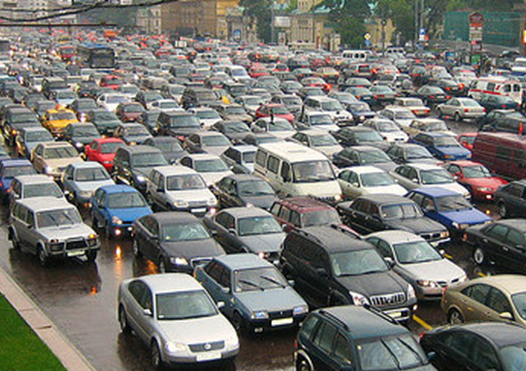
This is the top news nowadays. For residents of Bengaluru, the fact that the Air Quality Index (AQI) has breached the 100 mark has led to widespread cynicism. Many people are vociferous about the increased air pollution levels caused by heavy traffic and ongoing construction works. Indeed, the city is no longer the historical “Garden City” it once was. The innumerable residential construction projects and corporate skyscrapers have caused more harm than good. It is high time that the policymakers put a halt to the licensing of such construction and consider expanding to nearby towns like Tumkur. The increased migratory population has slowly started telling upon the most preferred Bangalore weather. Summers are prolonging, and more air conditioning units are seen near every balcony. Lifestyle changes have led residents to go for a second car. But comparing Delhi, Bangalore is far better. Delhi’s air pollution, which has breached 400 mark, is turning the city into a gas chamber. The situation is grim and worse when compared to top cities of the world. While Bengalurians may console themselves by comparing Delhi, they need to understand that Bengaluru is nowhere better than Delhi. Situated in the Gangetic plains, Delhi’s terrain resembles a bowl, which allows air pollutants to linger over the city for extended periods, particularly when mixed with winter fog. In contrast, Bangalore is located on the Deccan Plateau, giving it a convex shape. This topography causes air pollutants to disperse more easily, creating the impression that pollution is better managed in Bangalore. However, if increasing pollution is not addressed promptly, the city could eventually face the same challenges as Delhi.

Delhi faces several urgent challenges, including high vehicular pollution levels, ongoing construction, and harmful practices such as garbage and stubble burning from neighbouring states. These issues have been lingering for years, with no tangible solution in the near future. Doctors started advising patients to leave Delhi. While neighbouring states report a notable decrease in stubble burning, it is clear that the measures implemented by authorities in Delhi are insufficient. Additionally, residents of Delhi are often reluctant to step out of their comfort zones and opt for public transportation, despite the excellent Metro connectivity available in the city. In Bangalore, the situation is getting worse and inching towards a stage of no return. The fact that the AQI has crossed 100 is also a dangerous indication. If there is no tab on the new constructions, the PM2.5 level will definitely go up. Metro and flyover construction is severely delayed. Damocles’ sword hangs over the city as the 16.7 km, ill-conceived, unscientific Tunnel project prepares for its ground-breaking ceremony in February 2026. While Bangalore is gearing up to face the increased traffic snarls due to the tunnel project, it is worrisome to imagine where PM 2.5 levels will reach. God alone can save Bangalore!
Rare bird alert: Bangalore birdwatchers are in a frenzy!

Published in South Express on 22.11.25

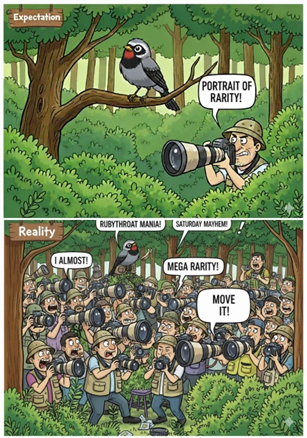
Himalayan Rubythroat spotted in Bangalore! This newspaper headline drove bird watchers mad, including me. Recently, when I was at Bharatpur Bird Sanctuary, as I came out of the ticket counter, an authorised guide tempted me to show the Himalayan Rubythroat. I hired him crazily, but instead of Rubythroat, he showed me cormorants and herons, the most common birds. When I returned to Bangalore, I heard that the bird had been spotted in Bangalore. This tiny bird with its bright red throat and distinctive calls is indeed a birdwatcher’s delight. It generally inhabits the Himalayas in the alpine meadows and dense bushes at elevations of about 3,000 meters above sea level. But how is it found in Bangalore? This is no surprise, as there are records in Kerala and Tamil Nadu of seeing this cute little bird. But the moment it is reported in the media, hundreds of birders start invading this place. Why do birders go crazy to photograph these birds? It is interesting to learn about human behaviour than bird  . Do they want to see more of the rare birds? Why are so many of them focused on spotting rare species? Why does sighting a rare bird catch the attention of the media? Is their main intention to record these rare birds and help save them from extinction? Many of the birds are slowly disappearing, including the state bird of Karnataka, the Indian roller.  Are we realising that these birds become rare due to habitat loss? What may be the thought process when they go in search of such rare species? Fun, adventure, hobby or commercial interest, what is it?

For a common man, when sparrows disappeared, it evoked little concern because he had more important things to worry about. For a media person, a bird’s disappearance or reappearance is just a headline to gain brownie points. For a politician, including an environment minister, there are many other priorities. For a bird photographer, what is his main objective in searching for a rare bird? There are a few kinds of nature photographers, one who has a commercial interest in rare sightings and the other who finds pleasure in posting rare birds on social media to attract more followers. For a naturalist, it is a conservation issue.  So what, if a few birds disappear? Coming back to the common man who has seen the extinction of a Dinosaur, it is the way the planet Earth will either eliminate the most unfit living beings (does it not remind us of Darwin’s theory of the survival of the fittest?) Ultimately, the small group of dedicated bird lovers passionate about birdwatching should focus on raising awareness about birds and taking practical steps to conserve them. They need to keep in mind the broader context of conservation as it evolves. Bird watching is not only a pleasurable activity but also plays a significant role in habitat conservation. We appeal to birders to emphasise the importance of rare birds, and all information about them, like their food sources and habitats. They must raise awareness on all platforms and contribute to the conservation of the ecosystem. “Birds can thrive without us, but humanity cannot thrive without birds”, said the renowned Indian ornithologist Dr Salim Ali. Let us not forget the golden words! (Photo courtesy: Social media post)

Why are Tiger Safaris closed in Bandipur & Nagarahole?

“Ecotourism has brought both excitement and challenges to the world of wildlife. Unfortunately, the surge in crowded safaris and the exuberance of tourists can intrude on the natural privacy that these majestic animals need”

Published in South Express on 15.11.25

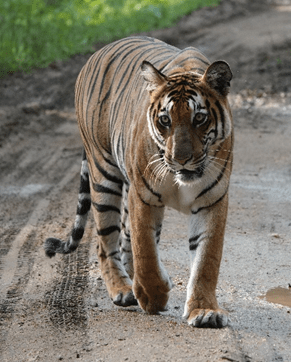
We made this observation in the South Express editorial on 2nd Aug 2025. Exactly after 2 months, we hear that the Karnataka Forest Department has suspended safaris in Bandipur and Nagarahole Tiger Reserves. The action is due to the tragic death of a 35-year-old farmer, Chowdaiah Naik, who was killed by a tiger near Hale Heggodilu in the Mysuru district. This is the third such attack in this area on a man by wild animals in the recent past. Karnataka’s Forest Minister Eshwar Khandre swiftly ordered the ban in response to local community concerns and instructed forest officials to capture the responsible tiger. While we appreciate the Minister’s prompt action, it raises concerns among eco-tourism advocates regarding the future of safaris in large reserves like Bandipur and Nagarahole. The main objectives of ecotourism are to conserve the natural environment, provide economic benefits to local communities, and educate visitors about conservation and local cultures. It aims to achieve this by promoting responsible travel that minimises negative impacts, respects local people, and provides financial support for conservation efforts. In the context of ecotourism, general tourists participating in safaris to experience the thrill of spotting a tiger in a natural forest often show little concern for conservation and habitat protection. Some even dare to go closer to the tigers and take selfies. Already, many incidents of such pseudo-adventure have been highlighted by the media. A signature campaign is currently underway to lift the suspension to protect the livelihoods of locals who rely heavily on ecotourism. Ecotourism can be a viable option if it is grounded in nature conservation and habitat protection. However, stricter rules and firm enforcement are necessary.

All safari jeeps should be equipped with recorded messages outlining the dos and don’ts when tourists are permitted inside the reserve forests. The practice of jeep drivers notifying each other and parading all vehicles around an animal must be banned. Hundreds of jeeps often rush to the location where a tiger is spotted, disrupting the animal’s privacy and peacefulness. Strict measures must be implemented to establish clear ethics for safari vehicles. India is home to two-thirds of the global tiger population. If compliance with regulations is ensured, revenue from ecotourism could enhance opportunities for wildlife protection.

Where are the migratory ducks?

Sardar Charan Singh appeared downcast when we boarded his e Rickshaw from the hotel where we stayed. E-Rickshaw No. 66 had not seen many tourists this season. As a senior birding guide with four decades of experience, Charan Singh, the authorised rickshaw driver, is more than just a driver. He shares insights about the woolly-necked stork, shovellers, Garganey, comb ducks, and the collared scops owl. While these uncommon bird species may not be so important to normal tourists, seasoned birders often seek out such unique names while chatting with the rickshaw drivers. To successfully capture images of birds like the Garganey, Gadwall, Red-crested Pochard, Comb Duck, Black Bittern, or Nightjar, birdwatchers often rely on the expertise of guides. Sardar knows exactly where the Nightjars are likely to be perched, ensuring that his customers leave delighted. However, Charan Singh was feeling dissatisfied this time. Due to the El Niño effect, the weather was unusually hot, even for November. Typically, this time of year would attract many migratory birds to Bharatpur. But Charan Singh is determined to show some special birds to the bird lovers. So, even before the birders get disappointed, he seeks permission to go to a nearby area, about a KM away from the national park.  Though initially it appeared a typical guide mindset to market something, a drive with him was not disappointing. The birds seemed to have taken a new abode, it looked like. We had a glimpse of all three species of Cormorants, Spoonbills, Openbills and night herons besides the usual egrets, jacanas, coots and moorhens. Thousands of water birds congregated here for hatching and breeding. It appears that the Rajasthan Govt had decided to convert this place into a heronry. At least this is what a rusted board indicated. When we returned to the Sanctuary and started moving inside, we were a little bit disappointed as there were not many water birds except Painted Storks in thousands. Charan Singh said that the breeding of Painted storks was delayed this year. Some common birds were also missing. Saurus crane was not seen anywhere. We were looking for migrants but were disappointed. Initially, we thought of making two rounds, one in the morning and another in the evening. But, realising that migrants were missing, we packed up and wanted to return. But Charan Singh took us around on unknown routes, trying to help us spot a few uncommon birds. Of course, it helped us to spot a Jackal and a spotted deer. But that is not what we looked for. Though the local guides still pin hope on the arrival of migratory ducks by November end, the fact of delay in migration clearly indicates that the El Niño situation may be intensified into climate change. In old books, there is evidence for counting 500- 600 species; the present-day guides estimate 300 to 400 species during the migratory season. The global hotspot, Keoladeo National Park, which looks deserted and dry, does not appear to have any hope for tomorrow. However, we could record 82 species of birds in 4 hours