
Published in South Express on 22.11.25
Himalayan Rubythroat spotted in Bangalore! This newspaper headline drove bird watchers mad, including me. Recently, when I was at Bharatpur Bird Sanctuary, as I came out of the ticket counter, an authorised guide tempted me to show the Himalayan Rubythroat. I hired him crazily, but instead of Rubythroat, he showed me cormorants and herons, the most common birds. When I returned to Bangalore, I heard that the bird had been spotted in Bangalore. This tiny bird with its bright red throat and distinctive calls is indeed a birdwatcher’s delight. It generally inhabits the Himalayas in the alpine meadows and dense bushes at elevations of about 3,000 meters above sea level. But how is it found in Bangalore? This is no surprise, as there are records in Kerala and Tamil Nadu of seeing this cute little bird. But the moment it is reported in the media, hundreds of birders start invading this place. Why do birders go crazy to photograph these birds? It is interesting to learn about human behaviour than bird . Do they want to see more of the rare birds? Why are so many of them focused on spotting rare species? Why does sighting a rare bird catch the attention of the media? Is their main intention to record these rare birds and help save them from extinction? Many of the birds are slowly disappearing, including the state bird of Karnataka, the Indian roller. Are we realising that these birds become rare due to habitat loss? What may be the thought process when they go in search of such rare species? Fun, adventure, hobby or commercial interest, what is it?
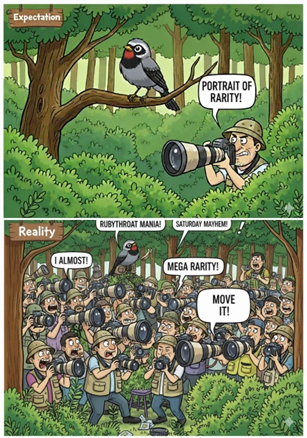
For a common man, when sparrows disappeared, it evoked little concern because he had more important things to worry about. For a media person, a bird’s disappearance or reappearance is just a headline to gain brownie points. For a politician, including an environment minister, there are many other priorities. For a bird photographer, what is his main objective in searching for a rare bird? There are a few kinds of nature photographers, one who has a commercial interest in rare sightings and the other who finds pleasure in posting rare birds on social media to attract more followers. For a naturalist, it is a conservation issue. So what, if a few birds disappear? Coming back to the common man who has seen the extinction of a Dinosaur, it is the way the planet Earth will either eliminate the most unfit living beings (does it not remind us of Darwin’s theory of the survival of the fittest?) Ultimately, the small group of dedicated bird lovers passionate about birdwatching should focus on raising awareness about birds and taking practical steps to conserve them. They need to keep in mind the broader context of conservation as it evolves. Bird watching is not only a pleasurable activity but also plays a significant role in habitat conservation. We appeal to birders to emphasise the importance of rare birds, and all information about them, like their food sources and habitats. They must raise awareness on all platforms and contribute to the conservation of the ecosystem. “Birds can thrive without us, but humanity cannot thrive without birds”, said the renowned Indian ornithologist Dr Salim Ali. Let us not forget the golden words! (Photo courtesy: Social media post)
 Dr V Selvarajan