
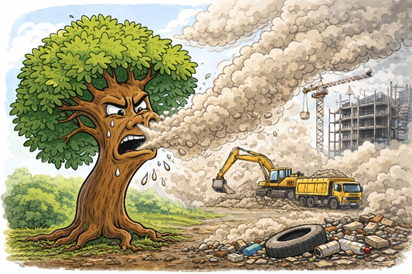
The title may perhaps generate inquisitiveness and encourage environmental activists to understand my perspective. Let me clarify why I chose the topic. The trigger was a project work, initiated by a student, pursuing his MCA. As part of his project work, he was doing an in-depth analysis of Bangalore’s ward-wise tree cover and its role in combating the rising Air Quality Index (AQI). Unlike Delhites, AQI is a term, perhaps, new to many Bengalurians, not discussed widely so far. Now, everyone in Bangalore knows what AQI is, as Bangalore’s air is also turning ‘toxic’, having crossed the 100-mark. At least this is what netizens are annoyed about nowadays. But, Delhites, don’t take this the wrong way—Bangalore isn’t trying to compare itself to you. You are top-notch when it comes to air pollution levels, with AQI readings at 800. It might take Bangalore years to reach your level. However, don’t underestimate the city’s potential. Bengalurians are confident that the AQI will reach your level. They pin their hopes on developmental activities: the ongoing metro construction, the upcoming tunnel road, the booming IT industry, and the influence of real estate interests, along with a government that often hesitates to heed expert advice.
Let me come back to the student’s thought-provoking study on satellite-based tree cover mapping and the area-wise relative AQI status. The research team called me to have my views on the study. I appreciated his efforts to map the tree cover and the AQI status even in small segments like Panchayats and wards. The research team was willing to consider my views. My first question was, ‘Will trees really come to the rescue in our battle against air pollution?’ The truth might surprise you: the answer is a resounding NO! Let’s explore why! Trees absorb carbon, but they cannot do the same for particulate matter (PM 2.5, PM 10) on leaf surfaces. Some studies show that the suspended particulate matter that gets deposited on leaves blocks stomata (small pores) on the leaves. Stomata in leaves are important for carbon absorption. In regions like Bangalore, with good rain (monsoon failures apart), those dust particles are washed, grounded, and leaves get cleaned up. But what about rain-starving places with more dust and carbon? Of course, trees act as natural filters to filter dust. However, the dust level remains uncontrollable due to ongoing construction activities in urban areas. While trees play a vital role in improving our environment, they cannot eliminate air pollution, as current pollution levels are too high to manage. A holistic time-bound approach is needed
 Dr V Selvarajan