Definition of mountains changing?

‘What is a mountain?’ If a teacher asks a primary class student, the future students may reply, ‘Any big rocky structure above 100 meters is a mountain’
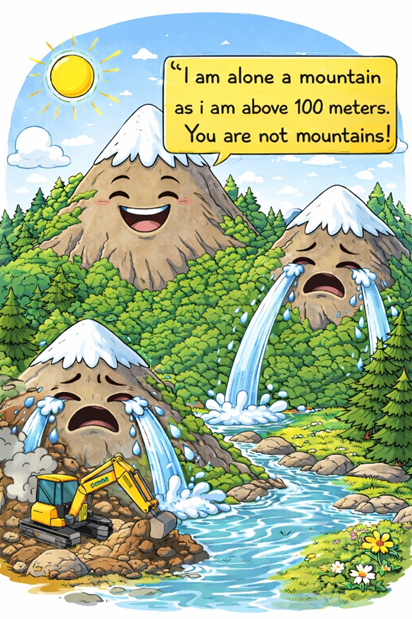
Mountains that are less than 100 meters in height may not be classified as mountains. This observation is from the Supreme Court’s judgment in the Aravalli case on 20-11-2025, not my own definition. The Aravalli range has largely vanished, leading to protests in North India, particularly in Rajasthan, Haryana, and Delhi. I have nothing new to say, as the subject has already been extensively presented by the media and on social media. My only question is how this 100-meter benchmark has been finalised. Why 100 meters, why not 50 or 25 meters? I do not find any logic or rhyme in such a decision. The decision is arbitrary and challengeable. However, the decision is currently on hold. We need to wait for the Supreme Court to review its decision and possibly consider new definitions in January 2026.

The Aravalli Range is one of the oldest mountain systems in the world, and it faces multiple serious environmental and governance issues, especially across Rajasthan, Haryana, and the Delhi NCR. The core issue is illegal Mining. Extensive mining of stone, marble, and quartz has been occurring. Environmentalists argue that the mining leads to hill flattening, loss of vegetation, groundwater depletion, and dust pollution. The mining mafia is not ready to yield. The second important issue is the clearing of forests for real estate, roads, resorts, and agriculture, which leads to soil erosion and loss of native species. The Wildlife corridors are slowly destroyed due to rampant urbanisation & Real Estate activities. Forest land reclassified as “non-forest” or “revenue land” to permit construction, especially in Gurugram, Faridabad, Alwar, and Delhi NCR areas. The Aravalli range serves as a natural groundwater recharge system, but its destruction has exacerbated the water crisis in Rajasthan, Haryana, and Delhi. The loss of the Aravallis removes a natural barrier against desert dust from the Thar and contributes to severe air pollution in Delhi–NCR. The reduced carbon sequestration has already started creating havoc. There is a threat to biodiversity, and invasive species are seen replacing the natural flora. When the court takes up the case again in January 2026, we hope that some goodwill will prevail and the Earth’s oldest mountain will be saved from destruction. In the name of development, let us not dilute definitions just to accommodate vested interests and then do the mutual mudslinging at the cost of sustainable development
Is open defecation still a problem in the 21st century?

My friend cautioned me, ‘Please be careful while walking.’

A few days ago, we went birdwatching at a location between Bangalore and Mysore. I prefer not to disclose the name on this platform. My friend was right in cautioning me. When I looked down, I noticed human waste everywhere. A long time back, I used to travel by train from Delhi Cantonment to Gurugram. On both sides, we used to see many people relieving themselves, unmindful of the train passing next to them. A luxury train (palace on wheels) used to pass the same route every Wednesday, carrying foreigners to see Jaipur, Jodhpur etc. We used to wonder what the tourists would think of our country.

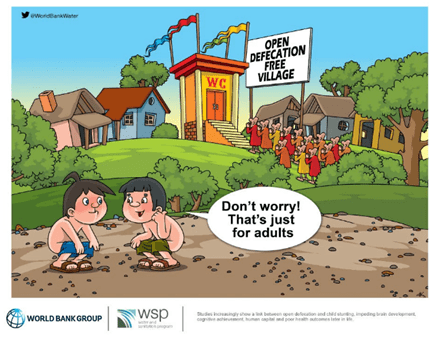
Whether it is a lake bund or any other water body, people do not hesitate to relieve themselves. And this is not an isolated case. And the situation is not just in rural areas, but Urban areas too. India is not yet open defecation-free (ODF), although the Government of India constructed 630000 public toilets under the Swachh Bharat Mission – Urban. This may sound exaggerated, but it is true. This count includes public and community sanitation facilities built to provide toilets in markets, bus stands, railway stations, parks, and other public places. Government data indicates that most villages have achieved ODF Plus status. However, external reports from various sources suggest that having a toilet does not guarantee its use. Neither the number ensures cleanliness of the public conveniences. Mindset is also an important factor. Many villagers prefer to choose open area. Lake bunds and river sides are easy targets. During our walk along the river and lakeside, just a fortnight ago, we were personally witness to this bitter reality. Most of the Southern states have access to household toilets, but in some northern states, such as Bihar, the situation is far below.  Some may have a wrong notion that human waste is biodegradable and nothing to worry about. Years back, a data was released about the water quality of river Yamuna at Delhi. At Okhla, a test conducted by researchers revealed that the Coliform bacteria (found in fecal matter) was a formidable 11.8 Crore in 100 ML as against the tolerant level of 5000 bacteria in 100 ML. So the bacteria may cause harmful disease if left in the open. Children may be infected easily. But we must not forget the reality. A full-fledged socio-cultural change besides economic improvement among common men need to blossom to accept the health aspects of cleanliness

DO YOU KNOW? 3.4 billion people still live without safely managed sanitation services – nearly half the world’s population.   354 million people still practise open defecation, increasing the risk of disease and harm, especially for women and girls. (SOURCE: WHO/UNICEF, 2025)

BBMP to GBA, is it ‘old wine in a new bottle’?

Published in South Express on 27.9.25

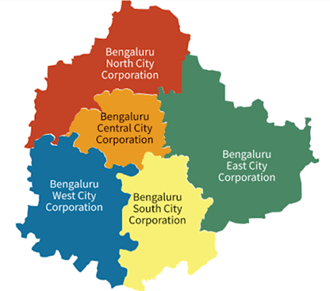
Will the Bruhat Bengaluru Mahanagara Palike (BBMP) perform better after being renamed as the Greater Bengaluru Authority (GBA)? Will the split of BBMP, now renamed as GBA work better? Will the five zones, that have now been formed serve the purpose for which they have been formed? GBA formed in May 2025, became fully operational in September 2025. The Authority has a three-tier governance structure, comprising the Authority at the apex, multiple City Corporations, and Ward Committees. It is hoped that the ward elections kept pending for more than 5 years will soon be held. As of now 350 wards are there in GBA’s jurisdiction. Even in 2015, it was decided to split the erstwhile BBMP into small corporations. The reason tabled by the Govt was that it was difficult to manage the city by a single corporation, given the ever-increasing population of Bangalore. The decision to split the former BBMP into smaller corporations was made in 2015. The government cited the growing population of Bengaluru as the reason, stating that managing the city with a single corporation had become increasingly challenging. In recent years, residents of Bengaluru have noticed a decline in the city’s overall condition, which is evident in areas such as garbage clearance, green cover, infrastructure maintenance, and other related services. Smaller municipalities achieve greater decentralisation, a key hallmark of good governance. There may also be a larger voice for the citizens and greater accountability towards them. In this regard, it may not be out of place to compare Delhi with Bangalore

In Delhi, there was a single corporation called ‘Municipal Corporation of Delhi (MCD)’ up to 2011. In 2012, the MCD was divided into three separate corporations: North, South, and East. The goal was to enhance regional efficiency since the area was twice the size of Bangalore. Delhi is not just another city. As the country’s capital, its governance has some special requirements. The trifurcation has led to economic imbalances, in addition to causing political controversies. In 2022,  Delhi reversed its decision and returned to a single corporation. Though there was a political hue and cry, it was finally decided to merge all three corporations. MCD thus had a rebirth. The citizens supported the remerger of the corporations since they hoped to get good governance, characterized by efficient and transparent service delivery.

In Bangalore, some experts believe that the division was unnecessary and implemented in a manner that will lead to uneven development in the city. Leaving aside politics, an effective decentralization will be in place if the authority is delegated to a dedicated committee. The city has to hold its Municipal elections immediately to ensure effective micro-management. Imbalances between corporations should be eliminated by apex-level policy management by the Greater Bengaluru Authority. The city is facing major problems, namely garbage clearance, potholed roads, overflowing drains, irregular water supply, and ever-rising traffic congestion. If decentralization can’t address these issues, then it will be nothing but old wine in a new bottle

(representative picture from the net)