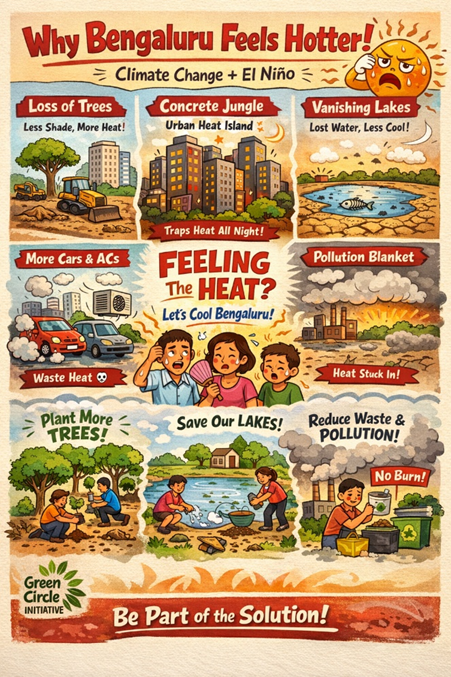
Extreme heat, due to El Niño or climate change or both?

In Bangalore, the current temperature (April) is 3°C to 4°C above normal, resulting in significant heat stress throughout the city. Bengaluru often gets “Mango Showers” in April, which provide temporary cooling. However, when the mercury exceeds 35°C, Bengalureans start lamenting climate change and blame the reduction of green cover as the main cause.

Bengaluru is not an isolated case. Interestingly, Delhiites say that the temperature is as usual hot and are prepared to face the usual extreme summer phase with forecasts reaching as high as 45°C by the end of the month. Some people have discussed the El Niño effect, which refers to the natural warming of the Pacific Ocean that occurs every few years and alters global weather patterns. So, can we attribute the current weather conditions to El Niño? In India, this phenomenon often leads to hotter summers and, at times, weaker monsoons. Thus, we can say that El Niño contributes to a temporary spike in temperatures that are already on the rise. However, this does not negate the impact of climate change. To put it simply, while climate change is a gradual and ongoing challenge, El Niño acts as an accelerant. Ultimately, the rising mercury levels are influenced by multiple factors, both natural and man-made, and these conditions are significantly affecting the livelihoods of everyday people. The question is whether we can reduce global warming, which is a big-picture concern and what little can be done at the local level. The octogenarian Bengalurean who saw the beautiful garden city once upon a time just laments and concludes, ‘We are already one step out, nothing could be done, it is the fate!’. A bureaucrat is half-minded. He has already subscribed to the ‘impossible’ intonation. As usual, politicians are relying on vote bank politics. The youth are preoccupied with their pursuit of a “bright” future and have little time for anything else. Meanwhile, the business world is focused on accumulating profits and prefers quick, shortcut methods to achieve its goals. The question of whether we can “pin hope” on the next generation is profound, as they inherit immense challenges while wielding unique strengths. Gen Z and Millennials exhibit remarkable resilience in facing global crises like COVID-19, passionately tackling systemic issues such as racial healing and environmental sustainability. Growing up in a digital world, they harness technology to solve complex problems, embodying kindness and ethics that inspire inclusive leadership. This generation is a force of transformation in fashion, culture, and politics, advocating for a brighter future. Our apprehension is how many will care for environment?\

Who is accountable for garbage dumping?

Rules may come, and rules may go! But garbage goes on overflowing!

Yes, we were eagerly waiting for 1st April 2026, the day on which the New Waste Management Rules were to be enforced. (We never forget that April 1st is Fools’ Day). Drastic changes have been proposed under the new rules. Recently, when I posted about the proposed changes in the WhatsApp group of a climate action group, someone said that there is no such proposal. Had I made a blunder? For a while, I was a bit upset because I felt guilty of misleading the public on social media. Instantly, I searched for the gazette notification of new rules for Solid waste management and posted it in the group. I do not have any resentment against the person who was unaware of the new rules. It only shows how the common man is sensitised to the proposed changes.  Yes, the 2016 Solid Waste Management rules have now been replaced by the 2026 rules, which took effect on April 1st, 2026.

The responsibility for achieving zero waste generation has largely been placed on individuals, who are the primary producers of waste. This aligns with the ‘polluter pays’ principle, which is understandable. However, what about the authorities? Our cities and even villages have experienced the worrying issue of unauthorized dumping. What repercussions can we expect if this trash is not removed promptly? Will the local authorities be made accountable for non-performance? If local authorities do not perform, will Pollution control boards take action against them? And if PCBs do not perform, will CPCB be made accountable? Who will take action? NGTs and Courts? When Courts have already been dumped with unmanageable cases, where is there time for them to take suo moto action? The role of civil society is crucial in this context. On one hand, there are individuals and institutions that find themselves held accountable for the shortcomings and failures of others, even when those shortcomings are beyond their control. On the other hand, it becomes imperative for these same groups to advocate vigorously against the lack of performance and inefficiencies exhibited by local governing bodies. Their involvement is essential in bringing attention to these issues, pressing for accountability, and ensuring that the community’s needs are met effectively.

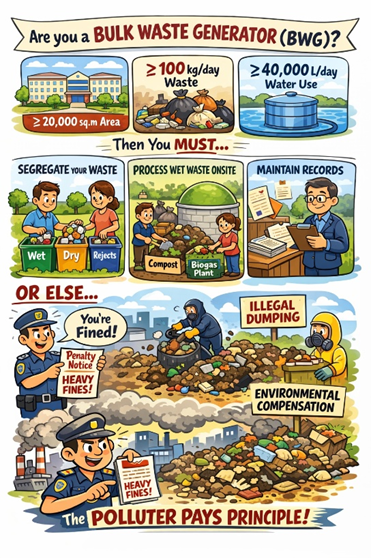
What are the key takeaways of SWM rules 2026? If your campus area is ≥ 20,000 sq.m or waste generated is ≥ 100 kg/day or water consumption is ≥ 40,000 L/day, then you are a Bulk Waste Generator (BWG) as per SWM rules 2026. Then you MUST ensure segregation at source, process wet waste onsite (compost/biogas) and maintain records. If you fail to do that, you will end up with fines and environmental compensation for dumping, under the Polluter Pays Principle.

Zero waste… it is impossible!

Quick answer: Yes, but not perfectly. What is the real answer? For that, please read this editorial fully.

International Day for Zero Waste! On 30th March, the world observes Zero Waste Day.  That’s fine. There are hundreds of international and national days. In fact, very few days, such as Environment Day or Earth Day, draw the public’s attention. Zero Waste Day has not gained much significance. But zero waste itself is the most talked-about topic nowadays. I wonder whether zero waste is ever achievable. The idea of Zero Waste is to design and manage products and habits so nothing ends up in landfills or incinerators. In practice, it means:

  • Reducing what you consume
  • Reusing as much as possible
  • Recycling/composting the rest

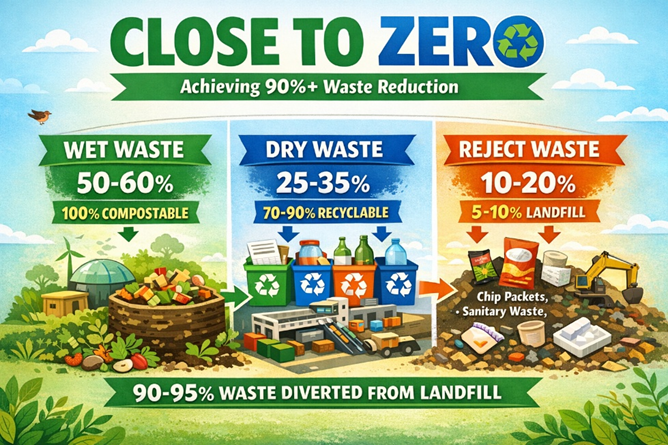
But can you reduce consumption to zero? Can you reuse the produced goods forever? One day or another, you may have to discard the same. Can you recycle the rest? For instance, let us take plastic material. One can reduce plastic goods. A cloth bag may be substituted for a polythene bag. Even if you buy some plastic bottles, you can reuse them for a few years. After that, a day will come when you have to discard the same. Then what are you going to do? Are you going to dump it in a landfill where it will take 500 years to degrade? It is nearly impossible to completely avoid generating waste. Therefore, it must be managed effectively so that it does not become a burden on society. Wet waste can be composted, while dry waste can be recycled. Some data suggests that we can reduce waste by up to 90%, and the goal of a circular economy is to achieve this reduction. In some highly disciplined communities, reductions of over 97% are possible according to certain studies.

In brief, I can say that zero waste is a direction, not a destination.