
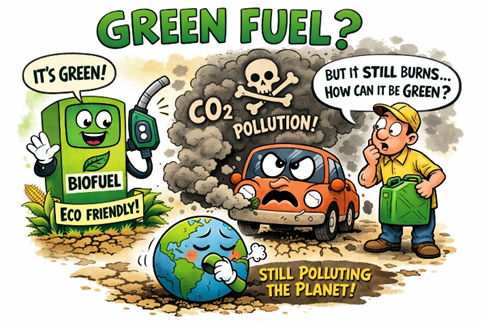
In today’s world, the terminology surrounding eco-friendly living is often both confusing and misleading, undermining the true essence of environmental responsibility. Could burning fuel be green? Could we burst crackers and call them green? Or do we really use biodegradable plastic? Green fuel refers to fuels that are considered eco-friendly because they emit lower greenhouse gas emissions and less pollution compared to conventional fossil fuels, namely coal, petrol, or diesel. However, the term is often used loosely, and sometimes misleadingly, in the public domain. CNG was considered an early green fuel. Non-conventional energy forms such as solar, wind, tidal energies are also considered eco-friendly and therefore ‘green’. And some advocate biofuel.When a fuel burns and emits carbon, how can it be green? Similarly, green crackers are just an ‘accommodating invention’ to appease the dogmatic beliefs. Green crackers are a category of firecrackers developed in India (mainly by CSIR-NEERI) to reduce air and noise pollution compared to conventional crackers. They were promoted especially after the Supreme Court restrictions on firecrackers. They are not ‘zero-pollution’ crackers but less polluting. The bitter truth is that the green crackers still emit particulate matter, sulphur compounds, nitrogen oxides, and CO₂. We can use the degrees of comparison for the ‘greenness’ of anything – green, greener and greenest. For instance, green crackers are greener than conventional crackers, but they are not the greenest. In that way, we can conclude that there is no greenest cracker. PM 2.5 peaks out during festivals, especially Diwali. We have reduced the bursting time to 2 hours, but not the volume of bursting.
Biodegradable plastic is not a solution to plastic pollution. Many products labelled as “biodegradable” do not actually break down in natural environments. For instance, Oxo-degradable plastics are not biodegradable but conventional plastics with metal salt additives. Microbes do not eat them, but they actually break down into smaller microplastics and nanoplastics. Plastics made from organic matter may degrade under industrial composting. Some plastics biodegrade but are costly. Some are partially biodegradable, as the plastic part remains as microplastics. One thing is clear, the world is yet to eliminate PLASTICS but tries to patch up, using biodegradability to its advantage.
In any case, GREENWASHING continues for sure!
 Dr V Selvarajan