
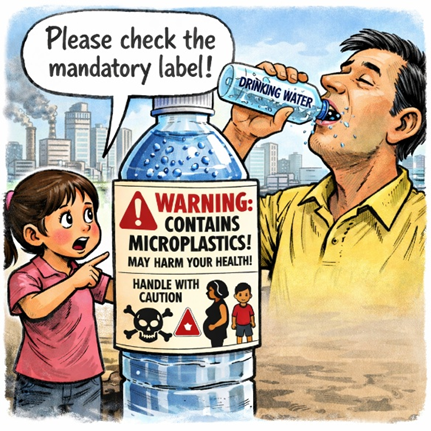
Can you see the microplastics? Where is it? For those who are not familiar with microplastics, they are extremely small plastic particles that range in size from 1 micrometre (µm) to 5 millimetres. To clarify, 1 micrometre (commonly referred to as a micron) is equal to 1/1000 of a millimetre. Because they are so small, we cannot see them, but we eat and drink them unknowingly. In particular, many researchers have been warning people to avoid drinking water from PET bottles. They claimed that the chemical reactions between plastic packets and bottles can induce cancer and other terminal diseases. However, it has been challenging to discourage people from using these bottles. Recently, a court made a landmark decision that may provide some respite in this matter.
The Madras High Court has raised serious concerns over the presence of microplastics in plastic-packaged food and drinking water, calling on the Government of India to introduce mandatory warning labels to inform consumers about potential health risks. The Madras High Court has raised serious concerns over the presence of microplastics in plastic-packaged food and drinking water, calling on the Government of India to introduce mandatory warning labels to inform consumers about potential health risks. Hearing writ petitions on plastic contamination, the Court observed that consumers have a right to know about exposure to microplastics—minute plastic particles that enter the human body through food and water. The judges likened the proposed warnings to health labels on liquor bottles, stating that such disclosures enable informed consumer choice. The Court highlighted emerging scientific evidence indicating that microplastics could pose health risks, particularly to pregnant women, children, and future generations, and also flagged the environmental consequences of plastic pollution entering the food chain. During the hearing, the Court was informed that the Food Safety and Standards Authority of India (FSSAI), under the Union Health Ministry, is conducting studies to identify and quantify micro- and nano-plastics in food and beverages. The research involves institutions including CSIR-Indian Institute of Toxicology Research, ICAR-Central Institute of Fisheries Technology, and BITS Pilani. Government submissions revealed preliminary findings indicating the presence of microplastics in commonly consumed items such as salt and packaged drinking water in several states. Pending final scientific conclusions, the Court stated that warning labels would serve as an interim consumer protection measure. Warning labels have no meaning in our humble opinion. We should not forget that the mandatory warning against smoking has not stopped the smokers. The stringent measures against public smoking alone had some impact. Soon, we will see one more slogan. SAY ‘NO’ TO MICROPLASTICS!


 Dr V Selvarajan