
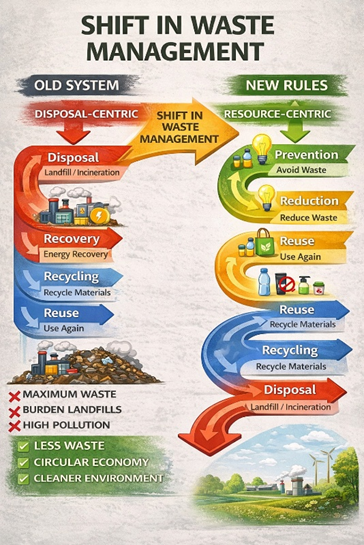
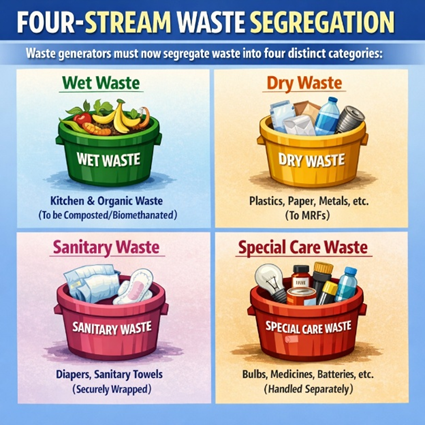
After a decade of solid waste management rules 2016, the present SWM Rules, 2026 is expected to strengthen solid waste management across urban and rural India, aligning with the circular economy and polluter-pays principles. Undoubtedly, there is a shift in waste management. From disposal orientation, we are moving towards resource orientation. The new rules are targeting mandatory 4 Stream Segregation at Source. This means that the waste generators must now segregate waste into four distinct categories: Wet waste, Dry waste, Sanitary waste and Special care waste. While the common man is somewhat familiar with dry, wet and Sanitary Waste, he may not be clear about Special Care Waste. They are bulbs, paints, expired medicines, batteries, etc. Segregation at source is now mandatory for all households, institutions, and establishments. Were the 2016 rules not mandatory? Anyway, there is no point in doing a post mortem. Bulk Waste Generator (BWG), a new term coined in the 2026 act, includes a new class of entities called buildings with 20,000 m² area, Entities consuming 40,000 litres of water/day and places generating 100 kg of solid waste/day. All BWGs must ensure segregation, collection, transport and environmentally sound processing of waste (e.g., onsite composting). If onsite processing isn’t feasible, obtain an Extended Bulk Waste Generator Responsibility (EBWGR) certificate. If enforced, 30 % of waste will be processed at source, reducing the burden on local bodies. According to the new rules, digital monitoring will ensure compliance. Improper segregation and false reporting will be penalised as per the ‘Polluter Pays’ principles.
Landfills will be used for the recycling of non-recyclables only, and not for dumping. The circular economy is given weightage in the new rules by strengthening Material Recovery Facilities (MRFs) and promoting the reuse of waste as Refuse-Derived Fuel (RDF) in boilers/cement kilns. The idea is to reduce dependency on fossil fuels. Visitor waste management fees will be implemented in hill areas to regulate tourist numbers according to waste capacity. The SWM Rules 2026 significantly enhance waste segregation, introduce digital oversight, increase accountability for major waste generators, limit landfill use, remediate legacy sites, and promote circular waste management in India—all from April 1, 2026. While the 2016 rules did not bring about any significant changes, will the 2026 rules set a new standard? All eyes are set on enforcement! We all live with hopes only!
 Dr V Selvarajan