
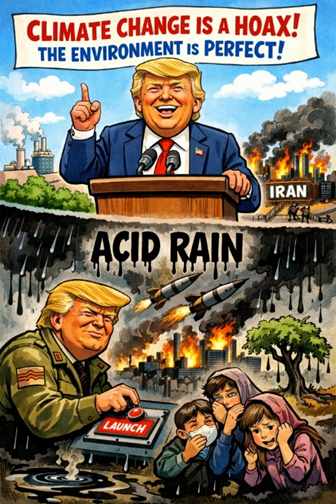
Perhaps the title seems unusual. In a materialistic world, it is a fact that nature and the environment may not concern everyone. This is what I have felt after participating in conservation activities for years. Recently, I saw a viral video from the USA. The speaker was highly critical of environmental activism, or, for that matter, he was also satirical about climate change. He is of the view that climate change is a hoax and environmentalists try to fool all by painting a gloomy picture that the climate is changing. Donald Trump dismisses climate change as a “con job” or “hoax”. He mocked Greta Thunberg in 2019, telling her to “chill” and work on her “Anger Management problem” Vivek Ramaswamy, during the 2023 Republican presidential debate, labelled the climate change agenda a “hoax” and claimed that “more people are dying of climate change policies than they actually are of climate change”. Andrew Tate taunted activist Greta Thunberg on social media, listing his 33 cars and offering to send details of their “enormous emissions”. Vladimir Putin described Greta Thunberg as a “kind, but poorly informed, teenager”. We are not going to debate who is correct, Greta or Trump. Because we are unequivocally sure of the impact of environmental degradation that is even visible to a layman. Our worry is about the apathy demonstrated by affluent nations in the global arena.
As of January 2026, the United States has officially withdrawn from the Paris Agreement on climate change for the second time. President Trump signed an executive order to withdraw on his first day in office, January 20, 2025, reversing the 2021 re-entry by the Biden administration. The U.S. is currently not a party to the treaty, as it is more concerned with domestic energy production. Yes, it is a global secret that Trump’s agenda was “America First” when he became President for the second time. His acts make one doubt whether America is his first choice or something else. The war in Iran has posed significant threats to the environment, as reports of acid rain have emerged from across the country. On one hand, Trump’s bombing actions are damaging the environment, while on the other, he claims to speak for world peace. His frequent statements have exceeded acceptable limits and are having a substantial impact globally. Additionally, the current shortage of LPG in India can be traced back to the consequences of the war. If climate change is a hoax, why do we discuss it almost every day? Why are sustainable development goals highlighted at every convention? Every individual who has lived for 60 – 80 years can remember how much better the climate was in the 20th century. Why are glaciers melting? Why are floods becoming more frequent? Why are barren lands increasing daily? Why are water bodies disappearing around the world? World leaders need to act with good sense on this matter.

 Dr V Selvarajan