
Rules may come, and rules may go! But garbage goes on overflowing!
Yes, we were eagerly waiting for 1st April 2026, the day on which the New Waste Management Rules were to be enforced. (We never forget that April 1st is Fools’ Day). Drastic changes have been proposed under the new rules. Recently, when I posted about the proposed changes in the WhatsApp group of a climate action group, someone said that there is no such proposal. Had I made a blunder? For a while, I was a bit upset because I felt guilty of misleading the public on social media. Instantly, I searched for the gazette notification of new rules for Solid waste management and posted it in the group. I do not have any resentment against the person who was unaware of the new rules. It only shows how the common man is sensitised to the proposed changes. Yes, the 2016 Solid Waste Management rules have now been replaced by the 2026 rules, which took effect on April 1st, 2026.
The responsibility for achieving zero waste generation has largely been placed on individuals, who are the primary producers of waste. This aligns with the ‘polluter pays’ principle, which is understandable. However, what about the authorities? Our cities and even villages have experienced the worrying issue of unauthorized dumping. What repercussions can we expect if this trash is not removed promptly? Will the local authorities be made accountable for non-performance? If local authorities do not perform, will Pollution control boards take action against them? And if PCBs do not perform, will CPCB be made accountable? Who will take action? NGTs and Courts? When Courts have already been dumped with unmanageable cases, where is there time for them to take suo moto action? The role of civil society is crucial in this context. On one hand, there are individuals and institutions that find themselves held accountable for the shortcomings and failures of others, even when those shortcomings are beyond their control. On the other hand, it becomes imperative for these same groups to advocate vigorously against the lack of performance and inefficiencies exhibited by local governing bodies. Their involvement is essential in bringing attention to these issues, pressing for accountability, and ensuring that the community’s needs are met effectively.
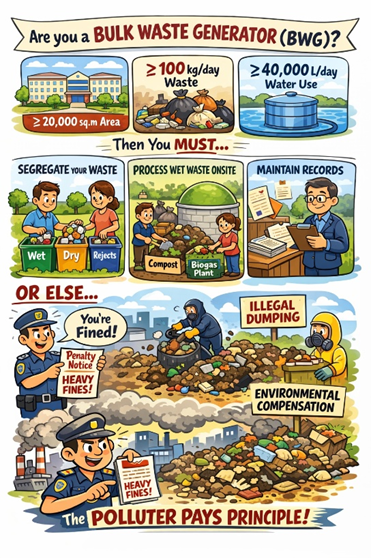
| What are the key takeaways of SWM rules 2026? If your campus area is ≥ 20,000 sq.m or waste generated is ≥ 100 kg/day or water consumption is ≥ 40,000 L/day, then you are a Bulk Waste Generator (BWG) as per SWM rules 2026. Then you MUST ensure segregation at source, process wet waste onsite (compost/biogas) and maintain records. If you fail to do that, you will end up with fines and environmental compensation for dumping, under the Polluter Pays Principle. |
 Dr V Selvarajan