
Quick answer: Yes, but not perfectly. What is the real answer? For that, please read this editorial fully.
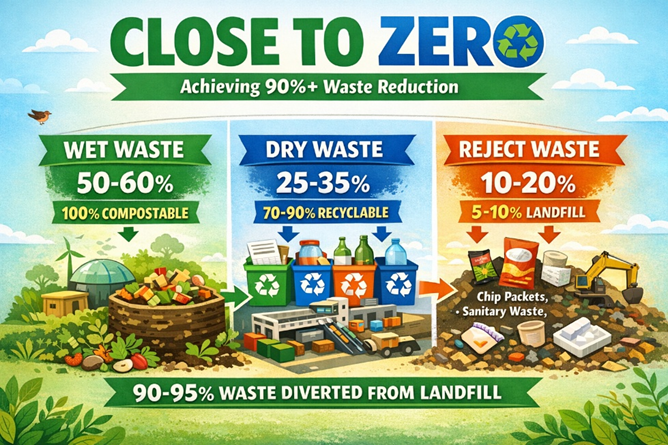
International Day for Zero Waste! On 30th March, the world observes Zero Waste Day. That’s fine. There are hundreds of international and national days. In fact, very few days, such as Environment Day or Earth Day, draw the public’s attention. Zero Waste Day has not gained much significance. But zero waste itself is the most talked-about topic nowadays. I wonder whether zero waste is ever achievable. The idea of Zero Waste is to design and manage products and habits so nothing ends up in landfills or incinerators. In practice, it means:
- Reducing what you consume
- Reusing as much as possible
- Recycling/composting the rest
But can you reduce consumption to zero? Can you reuse the produced goods forever? One day or another, you may have to discard the same. Can you recycle the rest? For instance, let us take plastic material. One can reduce plastic goods. A cloth bag may be substituted for a polythene bag. Even if you buy some plastic bottles, you can reuse them for a few years. After that, a day will come when you have to discard the same. Then what are you going to do? Are you going to dump it in a landfill where it will take 500 years to degrade? It is nearly impossible to completely avoid generating waste. Therefore, it must be managed effectively so that it does not become a burden on society. Wet waste can be composted, while dry waste can be recycled. Some data suggests that we can reduce waste by up to 90%, and the goal of a circular economy is to achieve this reduction. In some highly disciplined communities, reductions of over 97% are possible according to certain studies.
In brief, I can say that zero waste is a direction, not a destination.
 Dr V Selvarajan