The villages are gradually becoming dirtier, with garbage piling up for days and drains clogging. During my recent visits to nearby villages, I realized they are becoming extensions of urban areas, mirroring the same issues we face daily in towns. Single-use plastics are not a rarity in villages. Our visionaries like Mahatma Gandhi and Abdul Kalam brought innovative ideas of their times for rural areas. P.U.R.A initiative for rural development was the vision of Abdul Kalam. PURA, i.e., Providing Urban Amenities in Rural Areas, a concept by Dr A.P.J. Abdul Kalam, was a far-sighted vision. He dreamed of villages with physical, electronic, and knowledge connectivity, leading to economic connectivity, which would generate markets and bring prosperity to rural areas. Village Swaraj is Gandhi’s idea of self-reliant, self-governing villages. Now the village swaraj has turned digital with an e-Gram Swaraj portal and an app that covers more than 270000 lakh Panchayati Raj Institutions across 28 states and 6 UTs. So it is clear that the views of visionaries are being enforced. While we are in the process of empowering villages with urban comforts, it is also a fact that the villages are losing their natural atmosphere slowly. The environment is slowly degraded.
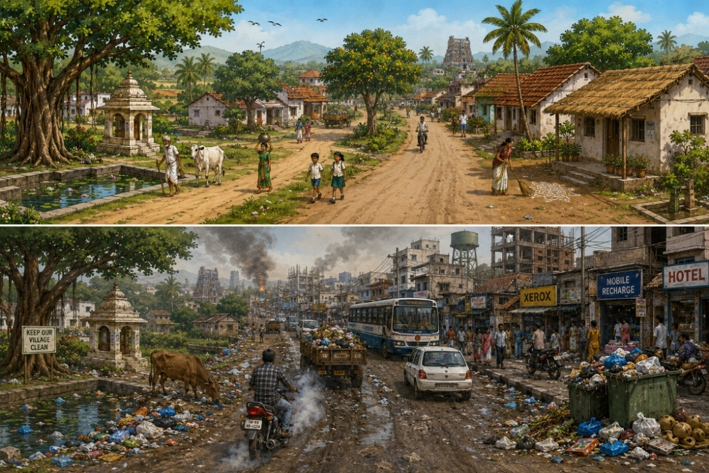
I do not blame the Government or the authorities for changing characteristics of the villages. People are to blame for their limited knowledge of modern amenities in villages. I am not against providing urban amenities in village areas. Neither modernization is a bad idea. But retaining the village environment and traditional activities such as cottage industry and agriculture is essential. There are more than 640000 villages in India even today. Indian villages have traditionally been known for clean surroundings, agriculture, water bodies, and a close connection with nature. However, rapid urbanisation, population growth, changing lifestyles, and a lack of proper planning are creating many social and environmental problems in rural areas. As we pass through rural areas, it feels like we are entering a miniature city. The rapid growth of farmhouses and resorts in the traditional villages poses a significant threat to the natural village ecosystem. I am genuinely quite concerned about this situation!