Are we colour blind?

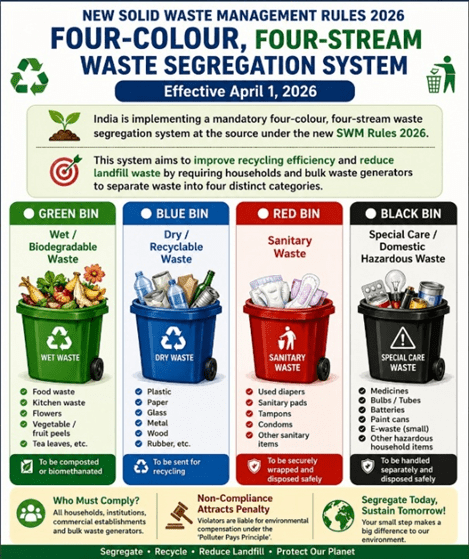
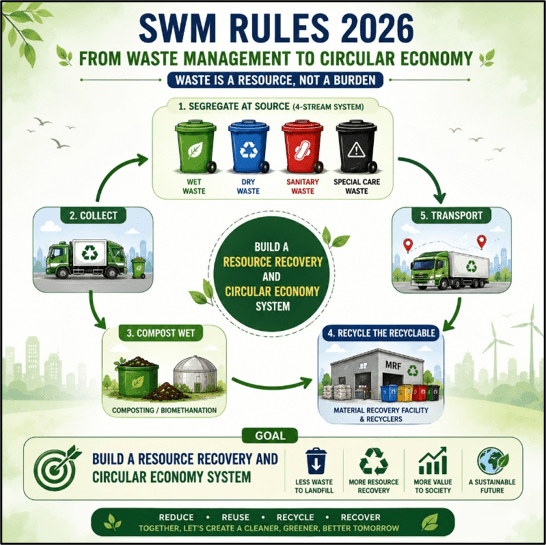
GREEN, BLUE, RED and BLACK! We all know these colours undoubtedly. The last time when I wrote about the four-stream segregation system, I relied on AI technology to generate four types of bins according to the Solid Waste Management Rules 2026, which were enforced by the Government of India starting April 1, 2026. However, I overlooked the colour codes suggested by these rules. Both the AI and I made an error in this regard. When someone pointed out the incorrect colour code in my representative sketch, I realised my mistake. The person who commented on my sketch in a social media group was quite vocal, urging me to withdraw it from circulation. She may be a municipal official, but I’m not certain. I assured her that I would correct the error, as it was indeed a mistake. It’s common for us to feel defensive when our mistakes are highlighted, but in my case, it was simply an oversight due to my reliance on AI. It’s important to remember that we learn through trial and error in life. But what is a big deal about colour? In the SWM rules 2016, two colour bins were highlighted, namely green and blue. But the reader will agree that not many were so concerned about the colour. We used the bins interchangeably. I have seen many green bins with dry waste and blue bins with mixed waste. Let the Municipal officials touch their hearts and say, how many followed the colour code religiously. When waiting for the boarding call at an airport, I sipped a cold drink from a Tetra Pak. Not so happy with the taste, I wanted to discard it in a blue bin, but I was in a dilemma whether the tetra pak was dry or wet because the wet content was still inside. A used toothpaste tube always has leftover wet contents. Swiggy or Zomato pizza and cakes had sticky food contents in the wraps. We used to dump the dry wrap with wet contents in dry bins. Google AI suggests that it’s better to put it in general waste than to contaminate dry recyclables. But where is the general waste bin? If General bins are also placed, everyone will use the same only. Then the very purpose of segregation at source is defeated. But, don’t worry, most of us are colour blind, and we will continue to mess up with the colours for sure! My main concern now is whether the 4-stream waste segregation system will be effectively followed. When discarding waste, individuals need to determine if an item is dry, wet, sanitary, or hazardous. However, the world is moving at a fast pace, and many people don’t have the time to consider these details. Additionally, education in our country is often insufficient for understanding the basics of waste management. Even those who are well-educated try to find shortcuts for disposal. Recently, I witnessed a high-end car speeding by, and someone inside irresponsibly threw a plastic bag of food waste onto the roadside. Would this obnoxious behaviour happen in advanced nations? It is another matter that we often boast that we are the third-largest economy!

Doing business with old clothes!

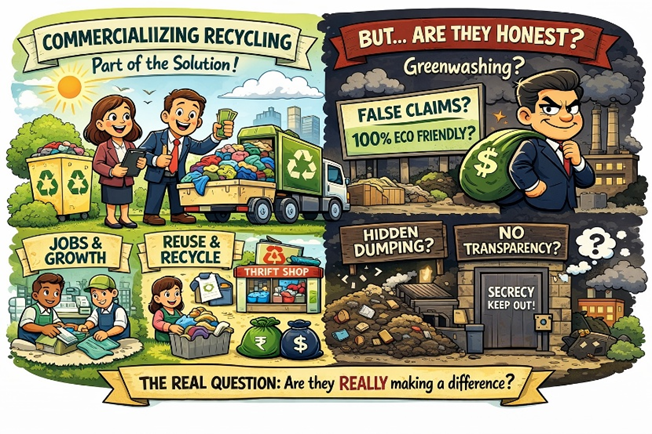
‘Sell your old clothes, and we offer Rs 20 per kilo!’ An advertisement drew my attention. ‘It is attractive. In my house, I have 25 KGs, why can’t I earn some extra income of Rs 500? But I can’t carry the clothes to their recycling yard, how to dispose of them?…’ ‘Don’t worry, we will pick them from your home and deduct a flat Rs 50’. ‘That’s fine, yet I will get RS 450. Not a bad deal!’   The process flow is as follows: You can schedule a doorstep pickup or use their smart bins located in apartments. They offer cash payment (approximately ₹20 per kilogram) for usable clothes or allow for free donations. This cloth recycling and resale platform helps individuals dispose of old clothes responsibly. They sort and grade the items received. Wearable clothes are resold, while damaged items are either upcycled or recycled. Additionally, some clothes may be donated or downcycled into other materials. India generates between 7 and 8 million tonnes of textile waste annually. Some startups have introduced recycling initiatives aimed at reducing landfill waste by promoting reuse before recycling. While diverting even a few tonnes of clothes from landfills is a positive contribution to the environment, we do not oppose such initiatives. However, we condemn the exaggeration and misleading claims made by some startups to attract more capital. Recently, we noticed social media reels from certain renowned platforms highlighting innovative ecopreneurs. One particular reel featured an ecopreneur, presented as an extraordinary young individual, who supposedly used innovative technology to address rainwater clogging in a southern state. However, upon inquiring with locals, we discovered that there is no such project in existence. Further investigation revealed that these upcoming entrepreneurs await huge CSR funding or venture capital, and such reels would help them to get brownie points. Does it not amount to greenwashing? Waste is a significant issue that we are facing, and time is running out. Every urban centre is becoming overwhelmed with garbage. What we need now is a concerted effort to address this problem. There is nothing wrong with pursuing waste recycling as a commercial activity; in fact, it can generate employment. Running a business focused on waste management is not a bad thing. On the contrary, it can inspire more young people to engage in social entrepreneurship. We wholeheartedly encourage this trend and hope that more youth will embrace ecopreneurship. However, any attempts to exaggerate the actions taken will ultimately hinder our progress.

Don’t use WhatsApp/Instagram frequently!

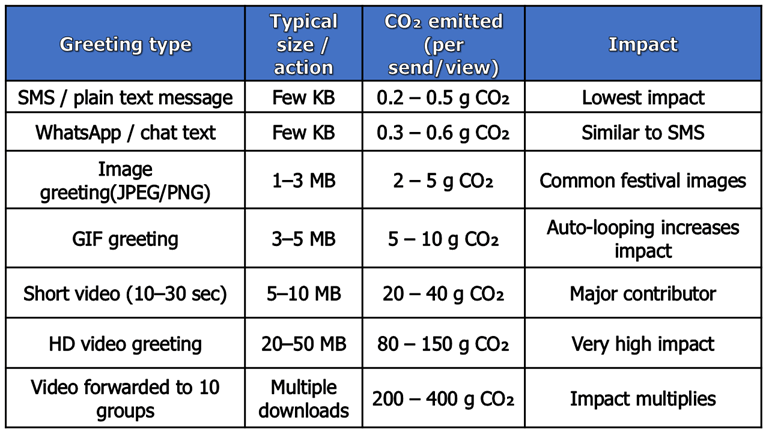
‘Your e-papers rely on circulation through social media. So, why are you stopping others from sharing these important messages?’ I can hear the whispers! That’s why I have cautiously used the word ‘frequently’ in the title. When we wanted to reduce paper usage, environmentally conscious persons started advocating the use of emails. Now it is time to caution against social media posts, or at least greetings. Digital greetings save trees and transport emissions, but excessive images, videos, and mass forwards quietly increase carbon footprints through energy-hungry data systems.  But the carbon footprint for online texting is better. We do not dispute it. The concern is about the huge volume of online messages. Data centres consume electricity as they process and store data at data centres, that run 24×7. They require electricity for servers and cooling devices, which is partly generated from coal or gas power. Every time we send a WhatsApp message, it travels through multiple servers. A Text message may consume very low energy, while a photo requires 10 times more data. Obviously, a video greeting requires hundreds of times more data. Sending the same video to many groups causes repeated downloads, multiplying energy use. Each greeting causes Screen lighting, CPU processing and Battery charging (indirect power use). So we can say that one message is tiny, but if it circulates a billion times, it matters together. Online greetings are still far greener than physical alternatives, but not zero-carbon. Cards with simple text or low-size images may be termed low-carbon cards. It is advisable to prefer them over repeated videos and autoplay videos. Deleting messages frequently is always good. We have given in the box the carbon emissions of online greetings, but they are only estimates, not precise. Understanding the impact helps. Instead of ignoring this topic, let us try to minimise usage to reduce harm to environment. Environmental challenges are subtle. It isn’t easy to decide what to give up and what not. Someone whispered to me that even our breathing releases CO2. That does not mean that we should stop breathing. When there is a significant impact on environment, it requires review.

“Digital greetings are greener than paper, but excessive images and videos quietly burn energy in remote data centres. Let us think globally and act locally”

Why do people throw garbage in unauthorised areas?

Published in South Express on 4.10.25

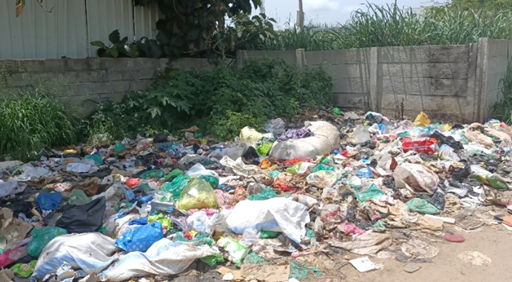
Swachh Bharat Abhiyan or Clean India Mission is a country-wide campaign initiated by the Government of India on 2 October 2014 to eliminate open defecation and improve solid waste management, and to create Open Defecation Free villages. As we enter the 12th year of Swachh Bharat Abhiyan, it is unfortunate that the mission has not evoked much interest. In other words, there is not much visible change in the garbage handling. Almost every municipality is struggling to manage the ever-increasing amount of garbage. I asked a question in a WhatsApp group to understand why individuals tend to throw garbage. From your WhatsApp survey, it seems people are aware of the problem but frustrated. Optimism exists, but anger dominates—showing that citizens want change but don’t feel empowered to make it happen. A few of the views that came up are as under “People lack civic consciousness.” “No dedicated garbage bins, periodically cleared.”“Independent houses have no lifting facility like apartments. “People don’t want to pay for garbage.” “No strict rules or enforcement of penalties.”

One member added, “7 years back, I was staying in Amrutahalli, Bengaluru. It was not so developed during those days. But garbage vans used to come, whistle near every house, and used to pick up garbage. The garbage pickers were responsible during those days.” In fact, this system is in vogue in some municipalities where even publicity songs are played by the collection van. Users put the garbage in the van daily. But all said and done, we still see the eyesore dumps in all cities. Talking about penalties, another member added, “Garbage cess is already imposed. Not sure whether the collection started? Community composting, as done in the HSR layout, is one option that can be thought of. Every street or group of streets can have a dedicated place for community composting for all the wet waste generated in the area.”  

It is a fact that civic sense and responsibility are missing or perhaps not much developed in India. Bengaluru was ranked the fifth dirtiest city in India in the Swachh Survekshan 2025 survey. Of course, this survey was made among the cities with a population above one million. Along with Bengaluru, Ranchi, Chennai, Ludhiana, and Madurai were ranked the top dirtiest cities. Unfortunately, some of the southern states that claim the highest percentage of education level have more unauthorized garbage dumping. Cleanliness is everyone’s responsibility. It is not fair if somebody keeps his home very clean but does not care about the surroundings. Every year, we remember Mahatma Gandhi on Oct 2nd, because not only is it his birthday, but also that the Swachh Bharat Abhiyan was rightly started by the PM on this day.

Why stubble burning is not there in South India?

Published in Dwarka Express on 26.11.23

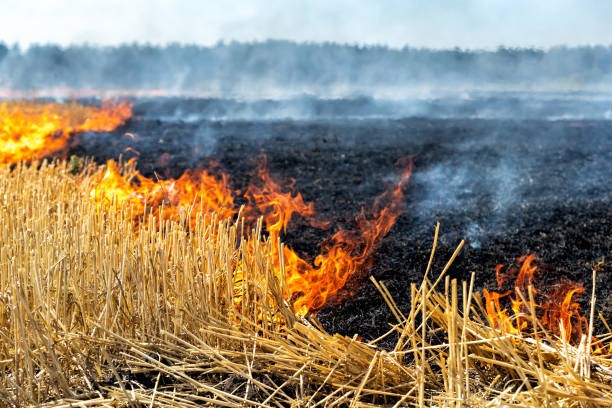
‘Delhi has become a gas chamber. It is not possible to breath’ grumbles a Delhiite. ‘Delhi is far better, Patna is worse’ says another, while there was another voice, ‘Haryana is worst’. Whatever may be the comparison parameters, the fact remains that the entire North is reeling under air pollution pressures as is evident from Central Pollution Control Board (CPCB) data. CPCB’s Graded Response Action Plan (GRAP) measures are put in place. Many medical advices are on air. But such stubble burning cases are not reported from South India. In south, the stubble is used as cattle fodder.

Why don’t the South India’s model be practiced by Punjab farmers to give up stubble burning. For one reason, the climatic condition in South is different from North. For any human action, there is some linkage to environment. Secondly, the crop seasons and patterns also make the difference. There are two main crop seasons in India, namely rabi and Kharif. Rabi crops like Wheat, Barley and Pulses are harvested during April to June and Kharif crops like paddy, Maize, Jower etc are harvested during Sep to Oct. In South, the farmers do not depend on wheat cultivation during Rabi and instead they sow pulses and millets. They are not in a hurry to plough the land and sow the seeds hurriedly. In Punjab and Haryana, farmers need to make frantic efforts to use the seasons and, in this process, they are in a hurry to prepare their lands for the next season. Especially the short gap during Sep to Oct make them go desperate to keep the land ready for the next sowing the rabi crop. Climatic changes worsen the situation. Especially the month of October is crucial and, in their anxiety, the farmers go for burning instead of trying alternate methods.  In 80’s and 90’s, North Indian cities like Delhi had minimal impact due to stubble burning. In olden days, the stems left out after harvesting grains, called fodder or tudi in Punjabi and used for cows, bulls and buffaloes as animal feeds. Nowadays, the usage of animals for ploughing is replaced by tractors. In South, the usage of animals is retained still. Traditionally also, festivals like jallikattu in Tamilnadu, Maramadi in Kerala or Kambala in Karnataka have been useful to retain the usage of bulls and buffaloes. In fact, farmers in Punjab also admit that the burning of stubble in the land spoils the quality of top soil and makes it unhealthy, besides polluting the air. Fodder serves as animal feed as well as natural fertilizer. Even as we consider alternate uses and ways to utilize or dispose stubble, the process is time consuming and the technology is not up to the mark as of now. The earlier machine used for converting the stubble into fertilizer proved slow and not economical. Thus, an estimated 10 million tons of stubble out of 22 million tons produced are still burned each year, causing severe environmental damage. Considering larger interest, Governments need to play an important role cutting across party politics, by subsidizing super seeder machines, incentivizing sale of fodders and encouraging short term paddy crops. This will enable the civil society to guard against the ill effects of air pollution