
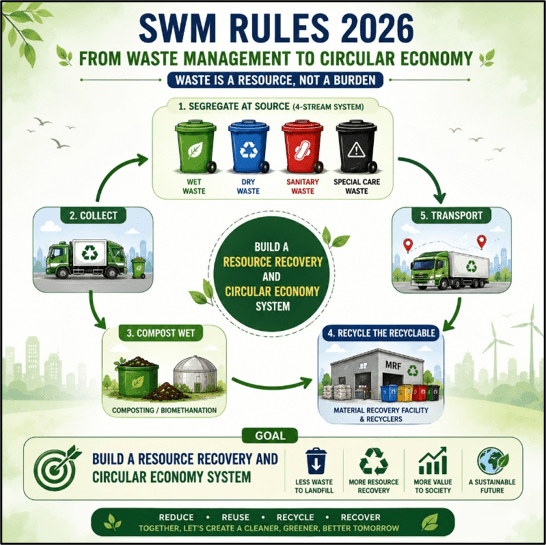
Yes, it should bring change and create a cleaner environment, ideally! But let us look back at the bygone decade. The old rules from 2016 have remained in effect for 10 years, and it’s time to say goodbye to them and introduce new regulations. The new rules were scheduled to take effect on April 1, 2026. However, when I shared my thoughts with South Express readers, I found that many were not well-informed about these changes. Are we serious about implementation? Even large institutions and apartment complexes that are expected to implement these regulations immediately (referred to as Bulk Waste Generators, or BWGs) seemed unaware of them. After 45 days, I now see some mentions of the new rules on social media, but I worry about whether SWM 2026 will garner much attention or face the same fate as the old SWM 2016 regulations. The fundamental concept of having separate bins for dry and wet waste, established in the 2016 rules, has still not been properly implemented to this day. Now, instead of two bins, we have moved to four bins. The government has initiated a more scientific approach in the current set of waste management rules. We need to transition from “Waste Disposal” to “Resource Recovery.” Instead of using two bins, we have now adopted a four-stream system that includes separate bins for DRY and WET waste, as well as SANITARY and SPECIAL CARE waste. Bulk Waste Generators now bear greater responsibility, as new regulations require compliance proofs. Apartments and institutions that generate 100 kg of waste, have an area of 20,000 square meters, or use 10,000 kiloliters of water, must segregate waste at the source. They are also required to start composting their wet waste on the premises. For dry waste and other types of waste, facilities must either recycle the material on-site or obtain the necessary EBWGR (Environmental Bulk Waste Generator Registration) certificates in order to transport the waste to a Material Recovery Facility (MRF). Moreover, a digital Governance is introduced to ensure stronger enforcement, clearly invoking the Polluter Pays Principle to create measurable accountability. In a nutshell, the vision is pointing to a circular economy to emphasize recycling and reuse, generate RDF fuel, encourage biomethanation and ensure landfill reduction
It is a far-sighted vision, undoubtedly, but the question is how it is going to be realized

