
Elections may come and go, but the flex menace continues! We have no grudge against the democratic process; however, the flex industry experiences a boom during elections. For flex users, it is cheaper, quicker and easier to produce. Flex banners are made from PVC (polyvinyl chloride) plastic and treated with chemical coatings. While they are inexpensive and waterproof, they are challenging to recycle and can be harmful after disposal. Flex banners do not decompose naturally for many years. After events, they often end up in landfills, lakes, or drains, or are improperly burned. According to India’s amended Plastic Waste Management and Single-Use Plastic (SUP) Rules 2022, plastic or PVC flex banners with a thickness of less than 100 microns are prohibited. To put it simply, 100 microns is approximately the thickness of human hair. Most of the flex banners on the market are thicker than this standard, allowing the flex industry to operate without concern about what happens to used banners. Additionally, the average lifespan of flex banners is only 4 to 8 hours. The SUP rules have comfortably forgotten that the flex banners used in India are between 150 and 400 microns in thickness. So, the SUP rules have no teeth to stop the flex menace. Today, we cannot think of a day without flex. All printers burn their midnight oil to meet deadlines.
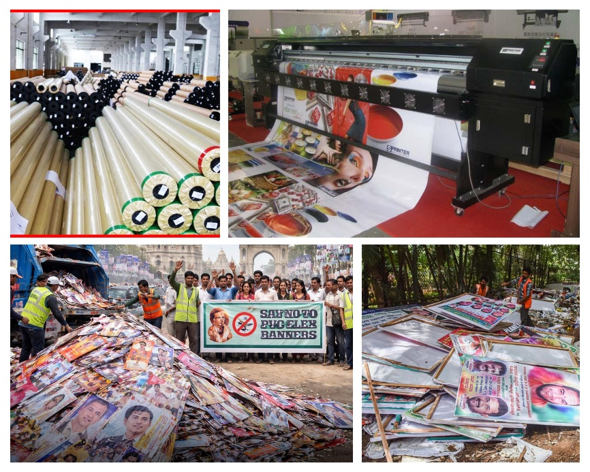
The flex industry has grown like anything. We learn that a formidable 250,000 to 500,000 tons per annum of PVC flex/banner material are produced in India. The turnover in monetary terms may be approximately ₹4,000 crore to ₹8,000 crore per year (combined manufacturing + printing + sales ecosystem). Flex banner material is only a small fraction of India’s total PVC use, but substantial due to the huge advertising market. What happens after an event? It remains uncared for or is getting dilapidated, ultimately to be carried away by municipal vans to the landfills. Flex banners can be recycled, but recycling is difficult, limited, and not widely organized in India. But mechanized shredding is posing a challenge, due to the chemicals and dirt present. Some NGOs are into upcycling, but that may be negligible. But somehow, we have forgotten the olden days when everyone used cloth banners, and flex had no role, but elections and public functions went on as usual. Even today, cloth or fabric banners are a better choice than the flex banners. I always use fabric banners for Green Circle programs, as the cloth banner Industry has almost vanished, and no cloth banner designers are seen nowadays.
Under these circumstances, the SUP rules must be reviewed to increase the banned size from 100 microns to 250 microns immediately.

