
World Environment Day often appears to be no more than a symbolic gesture. After participating in numerous activities organized to mark the occasion over the years, I sometimes wonder whether we are observing the day merely for the record. Plant a few saplings, conduct a plogging drive, organize competitions, or hold an awareness walk—these have become routine activities in schools, colleges, government offices, residential communities, and corporate campuses.
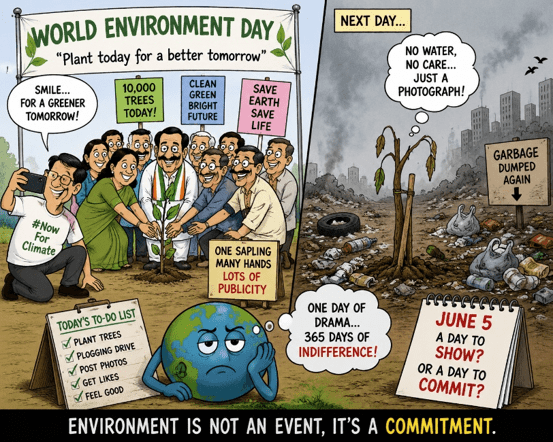
But to what end? Often, the primary motive appears to be uploading a few photographs for social media, school magazines, websites, or annual reports. Ten people posing around a single sapling, a group of children collecting a bag of plastic waste, or a handful of prizes awarded for essays and posters—these scenes are now familiar. Political parties, too, have joined the trend, with leaders posing beside newly planted saplings. One cannot help but ask: why all this showmanship? I must admit that I am not entirely free from this tendency myself. Knowing that littering is harmful does not automatically make someone stop littering or start cleaning public spaces. If taken seriously, tree planting and plogging can help bridge the gap between environmental knowledge and action. This raises an important question: why is World Environment Day observed across the globe in the first place? World Environment Day, led annually by the United Nations Environment Programme (UNEP), is the world’s largest platform for environmental public outreach. The first World Environment Day was observed on June 5, 1973. The day was established to raise awareness and inspire action on pressing environmental challenges such as climate change, plastic pollution, biodiversity loss, and wildlife conservation. Each year, countries around the world observe the day to highlight environmental concerns and encourage solutions. The United Nations also invites organizations and individuals to register their events on its global portal. Interestingly, India consistently records more registered events than most other countries. Ironically, this is precisely what worries me. When environmental activities become exercises in publicity and online visibility, we risk losing sight of their true purpose. What can one day of action achieve if it is not followed by sustained commitment? Protecting the environment is not a responsibility confined to June 5; it is a duty that belongs to each of us every day of the year. I am not suggesting that awareness programmes should stop. Indeed, they are necessary. However, we must develop a broader and more mature understanding of environmental stewardship. Activities launched on World Environment Day should extend well beyond June 5th. Planted trees should be nurtured and monitored. Plogging drive should lead to lasting cleanliness and behavioural change in that locality. The time has come to revisit the purpose of observing World Environment Day, particularly in India. The success of the day should be measured by the lasting changes we create—in our landscapes, our institutions, and, most importantly, our habits. Only then will World Environment Day become more than a symbolic gesture.


Leave a Reply