
KA, KA, KA… I still remember my grandmother calling crows by mimicking their calls. Within minutes, a flock would gather around her to enjoy the food she lovingly offered. As a kid, I found it fascinating. Today, however, as a birder and wildlife photographer, that memory often makes me wonder: where do we draw the line between attracting birds and disturbing them? An incident during my recent birding trip in North India brought this question into sharp focus. Two birdwatchers were engaged in a heated argument. One strongly objected to using a playback device to attract a bird, while the other, a local bird guide, defended the practice, arguing that it helped visitors see elusive species during their short visits.
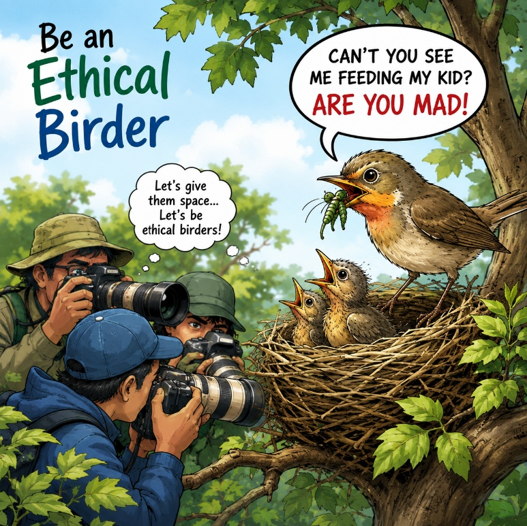
Listening to both sides, I realised that ethical birdwatching is far more complex than it appears. Another situation unfolded in Bengaluru last year when news spread on social media that a Himalayan Rubythroat had been spotted at a city lake. The next morning, nearly a hundred bird enthusiasts with powerful telephoto lenses gathered at the site to catch a glimpse of the bird as it emerged from the bushes. Yet the same people may walk past common birds like egrets or bulbuls without a second glance. The rise of social media and commercial wildlife photography has changed birdwatching in many ways. Wildlife photographers often travel long distances hoping to capture a rare image that will earn appreciation online. Bird guides, whose livelihood depends on satisfying their clients, sometimes use playback devices or mobile apps that imitate bird calls. Hide photography presents another ethical dilemma. These techniques may guarantee sightings, but they also raise an uncomfortable question: are we observing wildlife, or are we manipulating it? What may seem like a harmless shortcut for humans can become a significant source of stress for the birds. Many experienced birders avoid both hides and playback devices, believing that any deliberate attempt to influence a bird’s behaviour compromises the very spirit of birdwatching. For them, every sighting should be entirely natural, without disturbance. The debate is not merely theoretical. Last year, the Uttarakhand Forest Department reportedly prohibited hide photography in certain areas after complaints that some photographers were using meat and other baits to lure birds for dramatic images. Such practices clearly cross the boundary between observation and exploitation. Nest photography is another controversial subject. Photographers argue that long telephoto lenses allow them to photograph nests from a safe distance without using flash or disturbing the birds. Ethical standards often vary from person to person unless they are supported by law or by widely accepted professional codes of conduct. What one person considers harmless, another may regard as unacceptable. In wildlife conservation, however, a guiding principle has gradually emerged: whenever there is doubt, the welfare of the animal should take precedence over the interests of the observer or photographer.

