Is tree planting just for Guinness records?

Bangalore: 15 lakh trees in 12 hours! Bangalore launched a massive plantation drive recently. The BDA (Bangalore Development Authority) executed a mass afforestation drive, planting 15 lakh native saplings in 12 hours across 243 acres, and is aiming to achieve a Guinness World Record. Reality checks on complaints by residents have confirmed that hundreds of saplings withered, were left unplanted, or faced severe neglect, days after the world-record event. Citizens, environmental activists, and opposition parties have heavily criticized the drive, labelling it a temporary photo-op and “greenwashing” rather than a sustainable greening effort. Following the intense public backlash, the BDA defended the drive, stating that newly transplanted saplings naturally undergo temporary “transplant shock” and shed leaves before recovering. They assured scientific monitoring and rescue steps.

Delhi: 70 lakh trees in 6 months! Delhi launched its Mega Plantation Drive on July 7, 2026. Under “Ek Ped Maa Ke Naam” (A Tree in Mother’s Name) initiative, the target was to plant 70 lakh saplings across the capital this year.  While there is no record for the saplings planted, it is understood that about 3000 to 5000 were planted on the launch date. Govt. agencies are given huge targets to achieve this. No data is available to cross-check the planting and the survival.
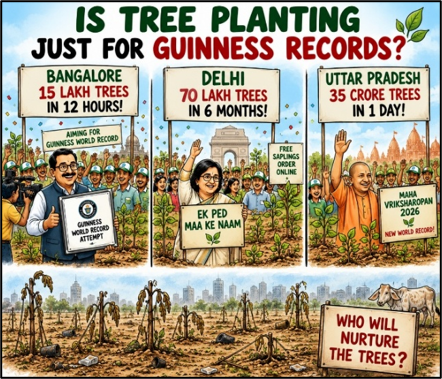
Uttar Pradesh: 35 Crore Trees in one day! Uttar Pradesh launched its state-wide “Mega Tree Plantation Drive 2026” on July 12 under the same theme, “Ek Ped Maa Ke Naam”. The state set a massive target of planting 35 crore saplings in one day to combat climate change and increase the state’s green cover.  From Anganwadi to the Highway authority, all were involved in the process. Uttar Pradesh created a world record by planting more than 35.27 crore saplings in a single day under the Maha Vriksharopan 2026 campaign. While we welcome large-scale plantation drives, we doubt whether planting trees is merely a one-time effort. A Government initiative can plant millions quickly, but saplings require at least two years of care to become self-sustaining. Trees need nurturing, with consistent watering and, if necessary, compost for inadequate soil. Tree guards are essential to protect them from grazing animals. One big question is whether these mass planting drives do have proper records to monitor the progress. Are they truly for greening our environment?

Do birds and animals need privacy?

KA, KA, KA…  I still remember my grandmother calling crows by mimicking their calls. Within minutes, a flock would gather around her to enjoy the food she lovingly offered. As a kid, I found it fascinating. Today, however, as a birder and wildlife photographer, that memory often makes me wonder: where do we draw the line between attracting birds and disturbing them? An incident during my recent birding trip in North India brought this question into sharp focus. Two birdwatchers were engaged in a heated argument. One strongly objected to using a playback device to attract a bird, while the other, a local bird guide, defended the practice, arguing that it helped visitors see elusive species during their short visits.

Listening to both sides, I realised that ethical birdwatching is far more complex than it appears. Another situation unfolded in Bengaluru last year when news spread on social media that a Himalayan Rubythroat had been spotted at a city lake. The next morning, nearly a hundred bird enthusiasts with powerful telephoto lenses gathered at the site to catch a glimpse of the bird as it emerged from the bushes. Yet the same people may walk past common birds like egrets or bulbuls without a second glance. The rise of social media and commercial wildlife photography has changed birdwatching in many ways. Wildlife photographers often travel long distances hoping to capture a rare image that will earn appreciation online. Bird guides, whose livelihood depends on satisfying their clients, sometimes use playback devices or mobile apps that imitate bird calls. Hide photography presents another ethical dilemma. These techniques may guarantee sightings, but they also raise an uncomfortable question: are we observing wildlife, or are we manipulating it? What may seem like a harmless shortcut for humans can become a significant source of stress for the birds. Many experienced birders avoid both hides and playback devices, believing that any deliberate attempt to influence a bird’s behaviour compromises the very spirit of birdwatching. For them, every sighting should be entirely natural, without disturbance. The debate is not merely theoretical. Last year, the Uttarakhand Forest Department reportedly prohibited hide photography in certain areas after complaints that some photographers were using meat and other baits to lure birds for dramatic images. Such practices clearly cross the boundary between observation and exploitation. Nest photography is another controversial subject. Photographers argue that long telephoto lenses allow them to photograph nests from a safe distance without using flash or disturbing the birds. Ethical standards often vary from person to person unless they are supported by law or by widely accepted professional codes of conduct. What one person considers harmless, another may regard as unacceptable. In wildlife conservation, however, a guiding principle has gradually emerged: whenever there is doubt, the welfare of the animal should take precedence over the interests of the observer or photographer.

Does water have no expiry date?

Recently, I came across a social media post that made me think: “What is the expiry date of water?” At first, this seemed like a simple question, but it raised interesting ideas about how we see water. Living in a busy city, I notice that our access to water affects how we think about it. For example, when I pour tap water into a glass and leave it out, I often feel it is “stale” by the next day.

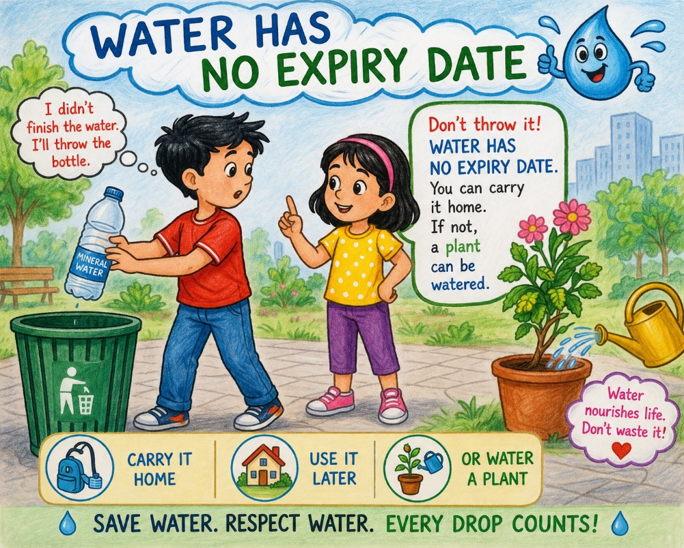
This belief feels automatic, as if water should have an expiry date. In other places, like villages where water is only delivered every few days, people treat water with great respect. For them, water can stay fresh for a week. This shows how those who depend on it cherish it, using it wisely in situations of scarcity. At events like weddings, a new bottle of Bisleri is often seen as better than one that has been sitting around for a while. In just minutes, people decide that the older bottle is no longer useful. Here, the expiry clock ticks quickly. In a recent mass marriage event in rural Bangalore, my volunteering team engaged in collecting leftover water from half-empty Bisleri bottles and poured them into a bucket. Later on, we used the water for plants in the nearby garden. In the desert, every drop of water is precious. While hiking under the hot sun, the water you carry is life-giving. Each drop remains fresh until you reach your next source, with its value depending on your journey, not a set time. Natural bodies of water, like lakes and ponds, can stay fresh for years, enduring droughts until the next rainy season. They remind us that the value of water is linked to the environment and our respect for nature. Water from borewells can be hundreds or thousands of years old, and it is often seen as very safe and pure. This highlights that what we easily discard in one situation is highly valued in another. All this makes it clear that water doesn’t have a true expiry date. How fresh we think water is depends on our mindset, environment, and its availability. When water flows freely, we may take it for granted. During times of scarcity, we appreciate its true worth. We must use this valuable resource wisely, with gratitude. Otherwise, our careless actions could leave future generations in need. I share this not just for reflection but as a call to action. Let’s value water and encourage conservation. Your actions today can make a difference tomorrow. (The story is based on a social media forward.)

AI drinks water!

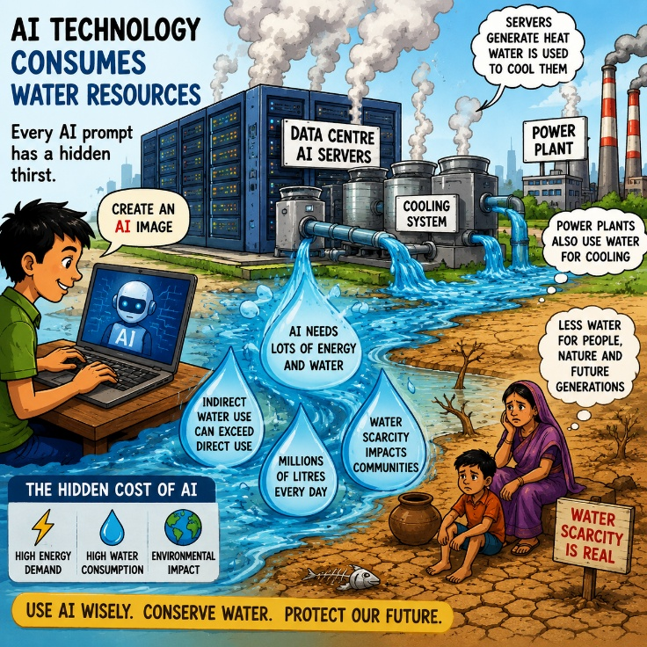
A recent social media post in our environmental group drew my attention. The guy who posted this in the WhatsApp group was a bit agitated. For a while, I felt that he was a not short of an exaggerator. But a second thought made me think that there must be some truth that needs to be explored.  I had no answer or clarity for the problem stated. The only way to understand the gravity of the issue is to search online. I decided to seek clarification through an AI route for this AI-related problem. I searched a lot. I had posed many questions to the AI browser. I had a convincing reply. But as AI says always, ‘AI need not be correct always’ Yes, AI does consume significant amounts of water. I systems run in large data centres filled with servers. These servers generate enormous heat and need cooling. Water is often used in cooling systems. AI requires huge amounts of electricity. Many power plants (especially thermal and nuclear plants) also use water for cooling. This indirect water use can exceed the water used inside the data centre itself. In an earlier editorial, (South Express 10.1.2026, I expressed concern about the high level of energy consumption in digital greetings. Though they are greener than paper, excessive images and videos quietly burn energy in remote data centres. In today’s editorial, I wish to bring to the kind attention of all readers about the water consumed on using AI technology. This does not mean that I am against technology but it is essential that we are aware of the issues involved. For that matter, history has showed how every innovation brings with it some concerns. We have seen how the fossil fuel is exploited in the last few decades and is now witnessing the symptoms of depleting natural resources. Similarly we all have witnessed the scarcity caused due to lavish use of water or for that matter any other natural resources. Here is the key role of Sustainable development. Hope that the planners and users of latest technology will take into account, all these concerns and work for a balanced growth.