Snakes are not allowed in apartments!

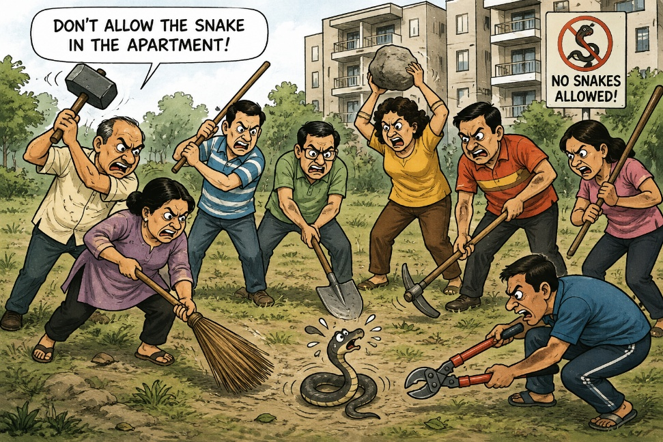
“Yes, of course. Don’t allow the snake in the apartment?” said someone in a WhatsApp group of a residential society. Social media is often the breeding ground for controversies. In one such post, a member raised his concern about snakes. He advocated that the open gym should be paved with concrete because snakes can be found in the grass. ‘I have stopped using the gym due to the presence of snakes and demanded immediate action against them’, he added, claiming they should be killed or they would kill him. At first glance, his demand seems genuine. However, let us understand the underlying issue. Some time ago, some residents complained about an increase in the rat population. Why are there more rats? Is it because the waste segregation room had leftover food, which provides a feast for the rats rummaging through the garbage? Or is it because there is no snake to eat them? Both are correct. Again, why hasn’t the garbage been removed immediately? Perhaps the volume of waste has increased. Why has the garbage increased? It’s because the apartments are now fully occupied. In summary, this is an environmental issue. Snakes once inhabited this area before construction began, and they have not forgotten their original home. But has any snake harmed anyone? No single incident has been reported. Ok, how big are the snakes? Are they poisonous? No one cared about the details. For a layman, all snakes must be killed, regardless of size. Who will stare at the snake to determine whether it is venomous or non-venomous? India, being a tropical country, is known for its snake varieties. We have only ‘Big 4 snakes’, namely Cobra, Krait, Russell’s Viper, and Saw-scaled Viper, whose bites are fatal. According to some unconfirmed data, only 15 of India’s 236 snake species are venomous. The rest are non-venomous. We agree that snakes are scary, and we need to protect the residents from their possible attacks. However, people should not forget the fact that snakes (reptiles) are an important link in the food chain. Given their size, habitat, and adaptations, it is common to find them in neighbourhoods. Quite often we read in newspapers that elephants intrude into human settlements because of habitat loss. If that is the case for giant elephants, is it possible to stop little snakes from entering apartments? Residents must maintain hygiene and cleanliness in their apartments. Concretization is not a solution. Snakes enter through grooves. While we prefer modern villas in natural surroundings, we must remember that animals, which are part of nature, should not be excluded. Humans often forget that all living organisms coexist. When necessary, snake rescue teams may be called to capture and relocate snakes to nearby jungles. However, the best option is to allow the snakes to move away on their own. Animals do not seek revenge; they react out of self-defence. Yeah! Since anacondas are not in India, we are definitely safer!
Why doesn’t India ban Single-Use PET bottles?

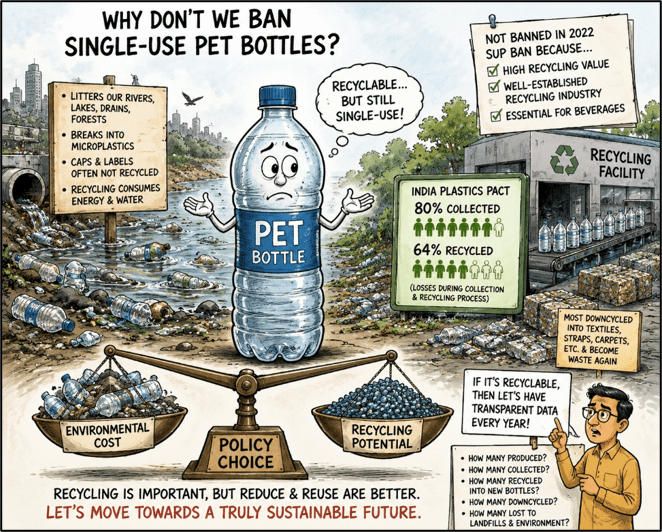
On July 1, 2022, India announced a ban on single-use plastics (SUP). The ban was well received, and many believed that this would alleviate a significant environmental issue, as SUPs are among the most harmful types of plastics. While we agree that plastic cannot be eliminated from use immediately, the SUP ban provided much-needed relief. However, it is important to note that the list of banned SUP items did not include PET (Polyethylene terephthalate) bottles, though they are also single-use items. The justification given for this exclusion was that PET bottles can be recycled, unlike polythene bags and plastic wrappers. PET bottles create major environmental problems.

We come across instances of used bottles being thrown into rivers, lakes, drains and forests. Such discarded PET bottles break down into microplastics. Caps and labels are often not recycled. Recycling itself consumes energy and water. Many recovered PET bottles are downcycled into polyester fibre, carpets, straps and other products, while only a relatively small proportion returns as food-grade bottles. Under Extended Producer Responsibility (EPR), manufacturers must collect and recycle a specified proportion of the plastic packaging they introduce into the market. According to the India Plastics Pact report, while 80% of PET bottles are collected, the estimated recycling rate is 64% due to losses during collection and recycling. India has one of the world’s largest PET bottle markets, yet CPCB does not publish an annual PET bottle status report. A product being “single-use” does not mean it should be banned. The environmental challenge now is to ensure that every PET bottle placed on the market is collected and recycled or, even better, reused – rather than discarded into the environment.  Our experience during the last four years suggests that PET bottle consumption has increased sharply, while littering remains widespread despite the recycling framework. A complete ban is unlikely in the near future because PET remains one of the most recyclable and economically recoverable plastics. However, if PET bottles should be exempt from the single-use plastic ban because they are recyclable, then the Government should publish transparent annual data proving how many are actually collected, recycled into new bottles, downcycled, or lost to the environment.

Why is there frequent fishkill in Bangalore lakes?

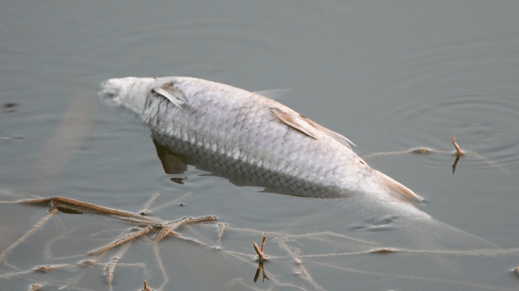
Imagine a scuba diver surrounded by water but unable to breathe the oxygen dissolved in it without special equipment. Fish, however, possess built-in “scuba gear” (gills), allowing them to extract oxygen from water. Unfortunately, they cannot utilize the abundant oxygen in the air because they lack lungs. Air contains about 21% oxygen, whereas water, even in optimal conditions, contains only 8–10 mg of dissolved oxygen (DO) per litre—thousands of times less than what is available in the atmosphere. Despite this, fish thrive because their bodies are adapted to extract that small amount of oxygen efficiently. Fish can survive in environments with very low levels of dissolved oxygen due to the high efficiency of their gills. However, those same gills do not function properly in air, even though it has a much higher oxygen content. Dissolved oxygen is the amount of oxygen gas (O₂) dissolved in water, and it is a crucial indicator of the health of rivers, lakes, ponds, reservoirs, and wetlands, as aquatic organisms depend on it for survival. Various organisms, including fish, insects, crabs, and snails, rely on dissolved oxygen, and beneficial bacteria require it to decompose organic matter. Low DO levels can cause stress, poor growth, and even death for aquatic life, making it a key parameter for assessing water quality. Photosynthesis increases dissolved oxygen levels, as aquatic plants and algae release oxygen during the day. However, DO levels can decrease due to several factors, such as higher water temperature, sewage discharge, organic waste, excess fertilizer, leading to algal blooms, stagnant water, industrial pollution, and nighttime respiration by plants and algae. As water temperature rises, its ability to hold oxygen decreases. For example, at 0°C, the DO level in water is 14.6 mg/L, while at 30°C, it drops to 7.6 mg/L. This illustrates why fish are more vulnerable during the hot summer months. Dissolved oxygen levels fluctuate throughout the day. For healthy aquatic life, a DO of 5 mg/L or higher is generally considered desirable. Many river monitoring programs in India use this benchmark to assess water quality. Different fish species have varying DO requirements; for instance, trout and salmon typically need DO levels above 7 mg/L, while species such as catfish and carp can tolerate lower levels. A sudden fish kill can occur when DO drops below about 2 mg/L. During algal blooms, oxygen may be abundant during the day but can sharply decrease at night, creating dangerous conditions for aquatic life. Oxygen is essential for the survival of all living organisms. For humans, the net oxygen intake is about 50 ml per liter, while aquatic life requires even less. Nevertheless, this small amount is crucial for their survival. If water levels drop or if the water becomes contaminated, fish can die from a lack of the minimum required oxygen. Therefore, it is essential to maintain water quality to ensure the survival of aquatic life.

Stop all Construction activities for one year!

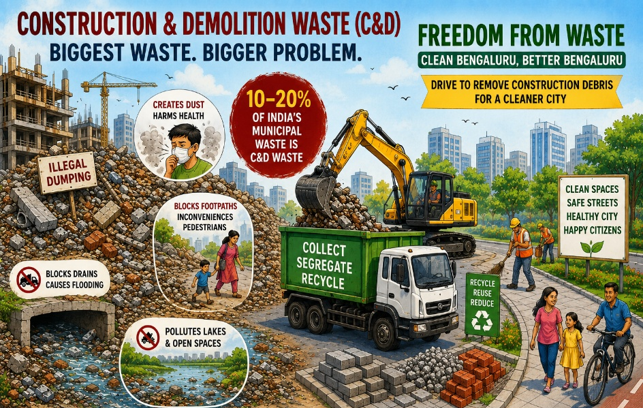
Of course, it’s a bizarre idea, I know, as many may find it ridiculous to halt construction entirely. Given the alarming rise in construction debris, it is important to discuss this matter. Recently, someone expressed interest in a WhatsApp group to remove all the construction waste next to her apartment. She laments that the debris is not only making the area look shabby, but is now a breeding ground for pests. But as usual, her thought ended in just a debate. Yes. Construction and Demolition (C&D) waste has become one of India’s fastest-growing waste streams, especially in rapidly urbanizing cities. Unlike household waste, it is often dumped illegally on roadsides, in lakes, in stormwater drains, and on vacant land. Every year, the country generates an estimated 150–500 million tonnes of construction and demolition waste, which is roughly 10–20% of all municipal solid waste.

Yet, most of it still ends up dumped on roadsides, lakebeds, and vacant land instead of being recycled into new building materials. The recent initiative by Karnataka’s Minister Krishna Byre Gowda is one of the most significant civic cleanliness campaigns undertaken in Bengaluru in recent years. Under his leadership, the Greater Bengaluru Authority (GBA) launched a month-long “Freedom from Waste” campaign beginning 1 August 2026. The objective is to reclaim Bengaluru’s public spaces by removing construction and demolition debris, long-standing garbage heaps, illegal dumping on roadsides and vacant plots, obstructions on footpaths and encroachments that hinder pedestrians. This is certainly a welcome initiative. I am reminded of Nek Chand Park in Chandigarh. The story of the Rock Garden in Chandigarh (created by Nek Chand) perfectly demonstrates that construction waste is not merely debris—it can become art, public infrastructure, and a cultural landmark. Built in 1957 on unused land, the Rock Garden, commonly known as Nek Chand Park, is created from broken bricks, concrete, tiles, ceramics, glass, pipes, and industrial scrap. Today, it stands as one of India’s most visited public gardens, attracting over a million visitors each year. The garden is a remarkable example of the principles of Reduce, Reuse, and Recycle, thanks to the vision of engineer Nek Chand, who played a key role in planning the city. Bangalore’s ‘Freedom from Waste’ campaign is more than a clean-up drive—it is an opportunity to transform waste into resources through recycling, restore public spaces to citizens, and make every builder accountable for the debris they generate. If sustained with public participation and strict enforcement, this initiative could become a model for every Indian city. Yes, we are sure that construction activities cannot be halted for a year. But our concern is whether Bangalore has a Plan B in place to handle future construction waste.