
Of course, it’s a bizarre idea, I know, as many may find it ridiculous to halt construction entirely. Given the alarming rise in construction debris, it is important to discuss this matter. Recently, someone expressed interest in a WhatsApp group to remove all the construction waste next to her apartment. She laments that the debris is not only making the area look shabby, but is now a breeding ground for pests. But as usual, her thought ended in just a debate. Yes. Construction and Demolition (C&D) waste has become one of India’s fastest-growing waste streams, especially in rapidly urbanizing cities. Unlike household waste, it is often dumped illegally on roadsides, in lakes, in stormwater drains, and on vacant land. Every year, the country generates an estimated 150–500 million tonnes of construction and demolition waste, which is roughly 10–20% of all municipal solid waste.
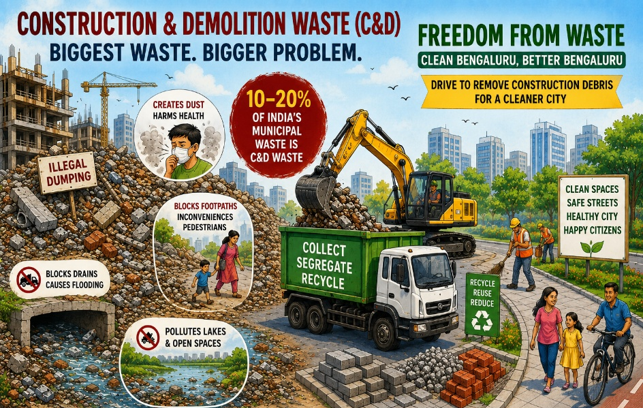
Yet, most of it still ends up dumped on roadsides, lakebeds, and vacant land instead of being recycled into new building materials. The recent initiative by Karnataka’s Minister Krishna Byre Gowda is one of the most significant civic cleanliness campaigns undertaken in Bengaluru in recent years. Under his leadership, the Greater Bengaluru Authority (GBA) launched a month-long “Freedom from Waste” campaign beginning 1 August 2026. The objective is to reclaim Bengaluru’s public spaces by removing construction and demolition debris, long-standing garbage heaps, illegal dumping on roadsides and vacant plots, obstructions on footpaths and encroachments that hinder pedestrians. This is certainly a welcome initiative. I am reminded of Nek Chand Park in Chandigarh. The story of the Rock Garden in Chandigarh (created by Nek Chand) perfectly demonstrates that construction waste is not merely debris—it can become art, public infrastructure, and a cultural landmark. Built in 1957 on unused land, the Rock Garden, commonly known as Nek Chand Park, is created from broken bricks, concrete, tiles, ceramics, glass, pipes, and industrial scrap. Today, it stands as one of India’s most visited public gardens, attracting over a million visitors each year. The garden is a remarkable example of the principles of Reduce, Reuse, and Recycle, thanks to the vision of engineer Nek Chand, who played a key role in planning the city. Bangalore’s ‘Freedom from Waste’ campaign is more than a clean-up drive—it is an opportunity to transform waste into resources through recycling, restore public spaces to citizens, and make every builder accountable for the debris they generate. If sustained with public participation and strict enforcement, this initiative could become a model for every Indian city. Yes, we are sure that construction activities cannot be halted for a year. But our concern is whether Bangalore has a Plan B in place to handle future construction waste.

