
On July 1, 2022, India announced a ban on single-use plastics (SUP). The ban was well received, and many believed that this would alleviate a significant environmental issue, as SUPs are among the most harmful types of plastics. While we agree that plastic cannot be eliminated from use immediately, the SUP ban provided much-needed relief. However, it is important to note that the list of banned SUP items did not include PET (Polyethylene terephthalate) bottles, though they are also single-use items. The justification given for this exclusion was that PET bottles can be recycled, unlike polythene bags and plastic wrappers. PET bottles create major environmental problems.
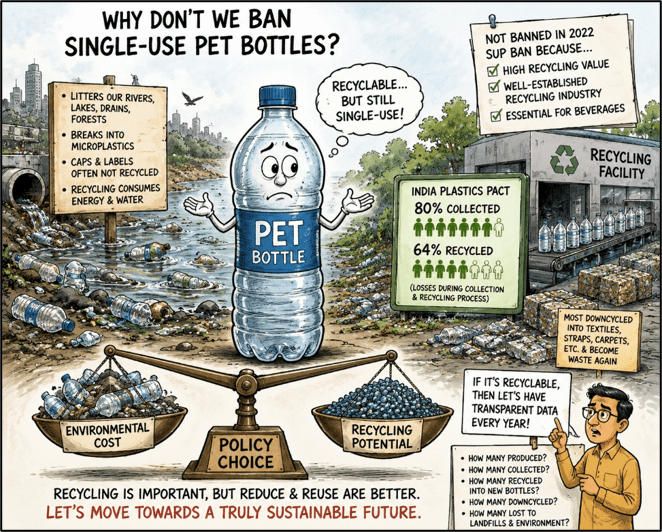
We come across instances of used bottles being thrown into rivers, lakes, drains and forests. Such discarded PET bottles break down into microplastics. Caps and labels are often not recycled. Recycling itself consumes energy and water. Many recovered PET bottles are downcycled into polyester fibre, carpets, straps and other products, while only a relatively small proportion returns as food-grade bottles. Under Extended Producer Responsibility (EPR), manufacturers must collect and recycle a specified proportion of the plastic packaging they introduce into the market. According to the India Plastics Pact report, while 80% of PET bottles are collected, the estimated recycling rate is 64% due to losses during collection and recycling. India has one of the world’s largest PET bottle markets, yet CPCB does not publish an annual PET bottle status report. A product being “single-use” does not mean it should be banned. The environmental challenge now is to ensure that every PET bottle placed on the market is collected and recycled or, even better, reused – rather than discarded into the environment. Our experience during the last four years suggests that PET bottle consumption has increased sharply, while littering remains widespread despite the recycling framework. A complete ban is unlikely in the near future because PET remains one of the most recyclable and economically recoverable plastics. However, if PET bottles should be exempt from the single-use plastic ban because they are recyclable, then the Government should publish transparent annual data proving how many are actually collected, recycled into new bottles, downcycled, or lost to the environment.

